27 February 2009

The Uncanny Valley

This weekend the University of Pittsburgh's theatre dept will host a Theatre & Cognitive Science Symposium. E & I--Theatre & Cognitive Science majors, respectively--feel the universe aligning ever so slightly.

E will be presenting a paper on facial expressions--a subject of enduring interest & study for Artists, Actors & Cognitive Psychologists. Among other things, this provides an opportunity to employ a term we've been eager to use in public:
The Uncanny Valley.

In brief, the Uncanny Valley is the slight but disturbing gap between a human representation that looks almost real, but not quite. We're talking about 3D animation, robots or sculpture. The hypothesis is that the 'not quite' element--this uncanny valley-- is upsetting to people, and much moreso than a facsimile that looks totally unnatural or completely convincing. Think of the creepiness of a B-grade wax museum.

The most fun thing I've seen on this recently is this graph below. This earnestly charts Familiarity across Human Likeness, comparing Moving vs. Still examples. The range runs from An Industrial Robot to A Healthy Person, and helpfully includes Humanoid Robots, Stuffed Animals, Bunraku Puppets, Corpses (still), Zombies (moving), and a Prosthetic Hand.

29 January 2009

25 Things

This is a meme from the Facebook world, asking people to write "25 Random Things" about yourself. Just for fun. Here are mine.

___________________________________________________

1. I once spent a night alone in an Alcatraz island prison cell. This was a Girl Scout field trip. I slept pretty well, too.

2. A few years back, I almost won the Ithaca ChiliFest Mechanical Bull-riding contest. A feat of skill & bosom. But an 8 year old girl took the trophy instead.

3. I can’t decide. I’d like to do both.

4. Yesterday I dreamed I was a tiny, speckled octopus. At the ocean’s surface, I transformed into a blue dragonfly and flew away.

5. That may be my oldest unconscious hobby: asleep, I sample the proprioception of really alien bodies. Like octopi & dragonflies. Like an octogenarian mailman. An oak tree. Wind.

6. At my next birthday I’ll have been a vegetarian (pescatarian) for half my life. I marked it by eating a duck, a rabbit, a buffalo burger & bacon at five star restaurants. They were good.

7. When I was a kid I climbed trees in my yard to pick cherry-plums, green apples, pomegranates and loquats.

8. That was a good tree, too--the best loquats I’ve ever had. I carried their chestnut stones in my pocket. Then a man named Wren Morningstar poisoned the tree—on purpose, they said, vindictively—part of an argument I never understood. For that treason my father ran him off our property and never spoke to him again.

9. I pray.

10. During a month-long trek through the Death Valley desert, I hiked ten miles out to a single payphone in the stark barren howling middle of nowhere, only to learn I’d been wait-listed at a graduate school. “Can I call you back tomorrow?” the director asked me.

11. Mostly, I don’t mind shoveling snow.

12. In the throes of back-country dog-sledding, I had the thought (a common one, this life): ‘This is really not fun at all, but I’m very glad to be here.’ Looking back now, I love every part of that trip.

13. I played defense on a soccer team called ‘Sloth Explosion’.

14. During the 1980s California drought, I participated in a rain dance choreographed by my great aunt, a magnificent grand dame who played the organ and sang and smoked from a long cigarette holder. We danced, we sang; it didn’t rain. But we all felt a lot better about life. I believe things like this matter.

15. A psychic once told me I was a cheerleader in a past life. I was 16 and took offense.

16. Once I played the carillon bells from a tower over Cambridge, MA. I did it badly—total cacophony for miles—but it was really fun.

17. Around the age of 9, I woke up with a powerful sense of déjà vu: I had been this age before, had done things like this already, long ago. I wondered then if THIS might not be my fabled second chance. I’ve never lost that feeling.

18. I spent about seven sleepless weeks fastening electrodes onto people’s scalps and analyzing their brainwaves while they slept.

19. In the outback of Australia, a horny jackaroo gave me a t-shirt he’d blown to shreds with a shotgun. “I shot it twice,” he said hopefully, a little shyly, as if that extra shot just might make the difference. I turned him down. But I still have the shirt.

20. In my late twenties, a truly ancient, toad-like Turkish woman molested me in a Parisian bathhouse. I had no retort.

21. I once waded across a clear, ocean inlet, the water to my waist—the only way across—only to discover two hours later the water cloudy with feeding sharks.

22. I hate bar soap.

23. The Eolian volcano Stromboli erupted while I was camped on its black-ash cone. Both guys with me at the time—including the Aussie we met on the trail & have not (yet!) seen since—recently found me on Facebook. We’re thinking of a 20-year reunion.

24. Though I hated the town of Irvine, CA itself, the trailer park I lived in there remains one of my favorite ‘neighborhoods’ yet. They bulldozed it soon after I left & paved it into a parking lot.

25. I once broke my foot jumping for joy. A challenging omen. So far, it’s the only bone I’ve broken.
_________________________________

03 June 2008

Congratulations, it's a _____!

TODAY JAM calls me in a state of bewilderment, all high & breathless off some emotion. She is 16.5 weeks pregnant. The obstetrician has called her at work about the genetic tests on JAM's blood sample.

The doctor, a calm & confident sort, confesses straight off that the lab has attached some wrong paperwork & that the pages are in a funny order. They don’t appear to have the test results quite yet. But she did notice one thing of interest here: Would JAM like to know the baby’s sex?

She & her husband had already decided they do want to know.

So the doctor tells her:
“It says here you have a perfect XX baby girl.”

AT this news, JAM has a huge rush of emotion, a burst of adrenaline. It’s overwhelming. The baby is not longer an It but a She. A Daughter. She's asking herself all at once: Is this what I’d expected? Is this what I’d secretly hoped for (or against)? What will this mean? How do I feel?

More: she suddenly knows her daughter's NAME---because they’ve already picked out one for each sex. She & her husband chose these, but something beyond Choice selected one & made it real.
She has a Name
.

The feeling hasn’t settled but the excitement is raw & good & intense.

These are important moments. The ecstatic ones that push us for an instant beyond language. The ones you can't prepare for no matter what you expected. A state like this one can carry you through decades of memory & leagues of emotion in milliseconds. It leaves you changed. You can't predict what will send you there.

HOWEVER.

While we're off capering through the miracles of Life, part of ourselves stays removed. Some people call this the Watcher Self, the rational part of us that remains detached & coolly observant (if not always helpful) through emergencies & delirium.

It's only about 2 or 3 seconds into this reverie when JAM's own brain interrupts. She's still on the phone.

Wait," she says to the smiling doctor. JAM can tell the doctor is beaming by the sound of the doctor's breath. Giving exciting news is the fun part of the doctor's day. "Wait a moment. I haven’t had an amnio. And you didn’t take the baby’s blood. So…how exactly do you KNOW the baby's sex?”

A short silence follows this excellent question.

“Huh,” says the doctor contemplatively. “You have a point there.”

Over the phone, JAM can hear pages flipping as the doctor consults the test results again.

"Ah-ha,” says the doctor in a lower tone. “On second glance, this says that…YOU are a girl.”

Congratulations!” I say. “You’re a girl!”


What 34 years of life & a 16 week pregnancy left us cause to suspect, medical science has now confirmed: JAM is female. She decided to write her mother at once with the news, given what a long time coming it’s been.

The doctor was appropriately embarrassed & promised to call back when actual results arrived. They won’t find out the baby’s sex for another 2 weeks, when they'll have an ultrasound.

Hanging up the phone, JAM is now left standing alone in her office, jittering with the inertia of this huge rush of emotion but with no actual knowledge of her baby’s sex--or name, or anything.

In fact, all she's learned is that she herself is a girl.

I sent her a card.

_________________

EPILOGUE:

It's a boy.

11 March 2008

Idylls of Winter

Glimpses of Minnesota

1. Dessert.

It is -5 degrees F. Yet we all decided to go out for ice cream.

The ice cream place was open. There was a line.


2. 25 February: Go Outside

E called me up from the university library to say, "You've GOT to go outside. It's warm. I'm walking around without a hat or gloves!"

I ran right out & took a long walk. It was amazing. Sunny! Warm! Suddenly: tricycles & inhabited tree-houses. Rabbits frolicked. Dozens of other people were outside with their kids & dogs, waving & shoveling slush. College girls mobbed along in shorts, Uggs & hoodies, singing. Beaming neighbors stopped to chat, full of bonhomie & the idylls of Winter, none of them with hats. Oh, wonderful world!

A February heat wave.

It was 37 degrees. There is not one leaf, not one blossom.

It's also the month of Muharram right now. This very day last year, I was sweltering in
Jakarta, hearing choruses of muezzins lament the martyrdom of Hussein. I can't believe it's been a year.

3. House of the Seven Nymphets.

It’s 7pm and dark, 14 degrees. We’re going out. Underneath our hats, mufflers, sweaters, coats & gloves, we're dressed up. And under THAT, we're wearing long underwear. My invisible long-johns, in a vain effort at unschlumping the season, have nice lacey cuffs. Which are necessarily tucked into my pilled wool hiking socks.

The moment we step from the house, however, we see that our car is parked in. There’s a giant gold SUV right behind it & a second giant gold SUV right next to it. Our next door neighbor girls, in the House of the Seven Nymphets, have bricked us in with gold. Students.

Before we even reach the car, however (waddling a little for the ice), a blond student comes streaking out of the house, all apologies, with the keys in her hand. “My friends TOLD me not to park here, sorry!”

So this was fine. She moved the car.

Thing is, this kid is wearing nothing but a bath towel. A golden towel & fuzzy backless gold slippers. That’s all. She bounded outside in 14 degrees to move the car in a bath towel. She didn’t even shiver.

THAT is Minnesota nice. (And Minnesota tough.)

4. Running in February

It’s 12 degrees but sunny. I stretch bungee & wire crampons over my beat-up runners. I'm wearing thick wool socks. This is a life or death event, running in winter. The sidewalks are unevenly shoveled: icy, cruddy, puddled or dry. If you don’t keep your eyes down & your ankles nimble, you will die a foolish death.

Also, if you forget the dog’s gentle-leader, any lunge for a mis-hibernating squirrel could result in a far more acrobatic & embarrassing demise. I wear gloves, a balaclava & sunglasses: because the sun is blinding off the snow. I sweat & freeze at the same time. My eyes & nose run. My thumbs & thighs go numb. My shoulders nudge my ears with shivering tension, yet I am hot.

By March, I have quit. I do sit-ups in my office.


5. 10 March: Put your gloves away

It’s heated up to a balmy 27 today with promises of 40 this week. The horrible lawn is showing through the snow like a dirty slip.

Spring is on our minds, though I (alone) am in no hurry. Winter is good writing weather. A few hearty rabbits have returned. People are giving up on hats & gloves en masse, but only because we feel it’s time to move on, not because it’s any warmer, as if it’s our collective rejection of winter clothing that actually brings the sun.

Any week now: crocuses.

04 December 2007

Persuaded

We're reading in bed, Evan and I. He's enjoying Woolf's "The Voyage Out"; I'm enduring Austen's "Persuasion". We've got our heads together, the dog cuddled between us. All by itself, this is pretty wonderful.

It's approaching 3:30 AM & we've been like this for a couple hours, frequently trading lines read aloud from our books: one astute, unveiling image after image from Virginia; one minute, stifling social trivium after another from Aunt Jane.
Both these books are in some sense consumed with women negotiating social minutiae, but they come at it from different passions.

I am feeling slightly guilty, possibly vulnerable, at not finding Austen so wonderful as I 'ought'.
And then, suddenly, precisely in turn, the characters from EVAN's book start discussing MY book. Literally: the set of friends in 'The Voyage Out' begin a debate over Austen's "Persuasion", some finding her genius, others finding her wholly tedious. Our fictional counterparts took over the discussion for us. When one of Woolf's characters begins to read aloud from "Persuasion", it causes another character--as forewarned--to fall asleep.

So we took our cue & went to sleep.

Life is art.

22 September 2007

Home Again

The Remaining Months of
A Year Without Winter


I won't be posting so frequently now that we're home and working toward deadlines.

But I WILL continue to post an entry every so often.
In fact, I have a long list of stories to tell you.

In the meantime, however, I've loaded a huge series of photos from our West Coast voyages, from San Diego to Seattle, then driving back to Minnesota. [Click on More of The Citradel's Photos, right].

Signing off for now, here's an iridescent spider web I found in Walnut Creek, California. Looks a little like something you might see from the space shuttle, doesn't it?


West Coast Tour, July-Sept 2007 008

01 September 2007

The Scandal of Innocence


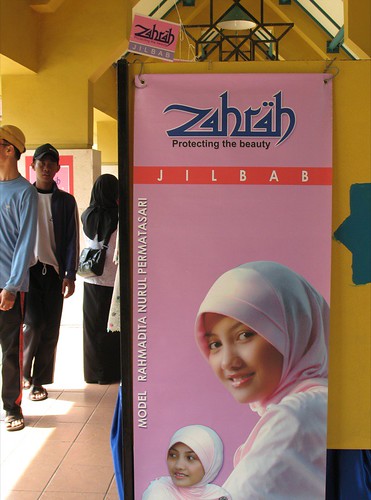
Not long after returning from Indonesia, I saw a little girl walking to a swimming pool wearing only a bathing suit & flip-flops. An arresting image to me after 6 months in the Islamic world.

We were in the California suburbs & it was about 95 degrees (F). She was 7 or 8 eight years old & holding her father’s hand as they strolled. She wore a brightly-colored, one-piece suit; nothing remarkable. He held her towel. She hopped a little, every fourth or fifth step—excited to swim. A simple, good image of summer. Here’s what stopped me:

To my Indonesian eye, she was effectively naked. Even after only 6 months away, this was genuinely startling to me. A spark of shock to see a child—a girl-child—undressed in public.

In more oppressive heat than this, no one in Jakarta, & certainly not a girl, walks about undressed like this. It would be scandalous & at least uncivilized. Not even boys wear shorts above the knee & high-necked tank tops, though a few women do wear them, are rare even in the cities. There’s a wide variety of dress in the metropolitan areas, but it’s not uncommon to see girls this young wearing long sleeves & jilbab (head scarf).

Now, suddenly, a girl walking down the street in a bathing suit.

But simultaneously my first reaction was split with a happy nostalgia! Because the truth is I grew up living 2 doors away from a public swimming pool in California & was a competitive swimmer for a decade of my childhood; I ran around dressed exactly like this little girl for 3 months of the year for most of my youth. I never thought twice about it; I was sexually innocent & I was universally treated that way.

This split reaction shows me how quickly & how much we can adapt to (if not adopt) new cultural mores. But it also shows how many contradictory values we can hold in one instant.

Here’s the kicker, though:
For all the surprise I felt at my own eye informing me ‘she’s undressed!’, this little girl looked strikingly INNOCENT. Specifically: she looked more innocent to my eye than the 7 year old girls I’d seen in jilbab. Because to me—in my outsider’s first reaction—it suggests that no one looks at this kid sexually. And that it rightly doesn’t occur to the father that anyone would.

Hijab (Islamic dress in general) is complex, of course, & people wear it for many different reasons, from cultural heritage to obedience to law, from fitting in with local fashion to expressing one’s devotion to God, & so forth, but one of the many reasons one might wear hijab is to block the male gaze. Concealing clothing, argue Islamic feminists, focuses men on the content of one’s character, rather than the too-tempting curves of one’s body.

The seven year old in hijab...I can’t know why her parents actually dressed her this way that morning, and from their perspective it may have nothing whatsoever to do with a sexual gaze. But from a distance, in general, to put a jilbab on a child suggests that some part of the public considers her—by virtue of being female—already engaged in a sexual equation.

It’s an unfortunate irony, this reaction. In certain, important ways we lose a measure of innocence exactly in the moment that we publicly declare it must be protected.


IMG_1098.JPG

28 August 2007

Looking Forward

29 June

Door to door, it took me 40 hours to get from Sydney to St. Paul. I had to fly back to Indonesia first. Not because it was sane, but to pick up the other half of my original ticket.

Near the local midnight I met Evan in the airy aisles of the Jakarta airport, the humid air a gentle déjà vu...back in Indonesia. I was glad for this last glimpse of it. Evan was standing between a public telephone decorated with carved demons & a shop selling nothing but dried shark fin.

We hadn’t seen each other in 5 weeks. During his last month in Indonesia he’d acted in a play, interviewed a dozen people, wrote a chapter & traveled far & wide. He’d also lost 20 pounds to Inside-Out Fever. But he’d recovered by now & looked good: sleepy but exhilarated. It's been a great month for both of us. We were so happy to see each other again.

On the plane ride home we made two lists, one of things we were most looking forward to upon returning home. The other of things we would miss about Indonesia. Here are the lists:

Most Looking Forward To Upon Returning:

• Friends & Family
• Our dog
• Irony
• Sarcasm
• Public displays of affection
• Secularism
• Silence
• Safe & tasty drinking water
• Traffic lights.
• Unpolluted air
• Public candor
• Organized ecological conservation
• Alpine mountains
• Running outside
• Tank tops & shorts
• WINTER

What We’ll Miss about Living in Jakarta:

• The organic flow of crowds & traffic.
• Rambutan, mangosteen & snakeskin fruit.
• The ease of rapport with & support from other artists, even famous, busy & powerful artists. Community is easy to find.
• Similarly, the ease of visiting or interviewing anyone we sought.
• The view from my balcony.
• The singular focus of our time.
• The street-level sense of ‘chaos’ (in contrast to the more dominant aesthetic of ‘control’ in Europe & the US).
• The sheer degree of public calm & politeness.
• The lack of street crime or sense of possible violence.
• Physical ease of men with each other (manly men will hold hands, sit with their arms draped over each others’ shoulders, touch each other easily with no connotations of sexuality whatsoever).
• In the arts, culture, & television...these freedoms are young enough that their markets are not glutted. While the quality is often poorer than what we can find at home, the field is very open. There’s a great deal of new freedom, energy, openness & room to explore & expand. There’s corruption & censorship, but no Old Boys’ network running the shows.
• The energy of a new democracy in its formation: lots of active discussion at all levels of who we are, what do we believe in, & how will we direct our laws & labors. It's a very exciting time & place to be.
• The opportunity to live in a land steeped in religion (& then to leave it).
• Affordability of food, house-cleaning, massage & child care.

A sense of cheerful pragmatism & inspiration. As Putu Wijaya said, “Make use of what’s there.”

29 July 2007

Republik Mimpi

15 & 20 May
Jakarta, Indonesia


Twenty-five years ago, with a Masters in Buffoonery, RJ worked as a Ringling Bros clown. Later, he ran away FROM the circus & went to Harvard, where he got a PhD in theatre.
I think I'll leave his story at that.

We met this wonderful person in Indonesia as a fellow Fulbrighter. He graciously invited us to join him at the live broadcasts of several important television shows in Jakarta.

RJ was interviewing the fearless & inexhaustible Effendi Ghazali, once a Fulbright scholar himself at Cornell University, now writing, hosting & producing 3 different programs. Effendi’s shows are fast-paced, hotly topical, often funny (if not outright ludicrous), & always on the verge of government censure.

The one I saw taped was City Views, a more sedate, contemporary issues talk show. The night’s theme was domestic violence. The panel of Effendi & several experts sat in brightly lit couches. A super-sunny young pianist with a radio face & giant smile of tiny teeth played elevator music into & out from commercial breaks. On the other side of a partition, unnamed & filmed in shadowed profile, was a battered wife, a small, shy & nervous young woman in brown hijab.

Effendi casts a wide net. He’s pointedly criticized the Indonesian administration, poked at scandals of financial misconduct, beat the drum for a viable energy policy, for housing for the poor, for more affordable & available books, for flood relief....now a story on wife beating in Islamic households.

I sat on a chair about 12 feet in front of her while interns whispered into headsets & tried to pass around tic-tacks without making any noise. She was eloquent & simple, & slipped away the moment it was done.

MIMPI

E joined RJ on a further filming of Republik Mimpi—the Republic of Dreams—which I later saw on television on 20 May, the Day of National Awakening, E at my ear translating.

With some justice, Republic Mimpi is said to be the Indonesian version of The Daily Show. Not quite, but I can see what they mean. It is a political satire with sharp edges & ridiculous flares.

The rotating panel of characters are thinly-veiled mimics of actual Indonesian leaders, which is partially where all the heat comes from. Effendi hosts as their ‘communications adviser.’ Not only does the audience get a chance to hear (funny) ventriloquisms of “their leaders”, but they get to pose direct questions to those leaders. Deeply couched in jokes, the topics & the questions are real. More than a few times, Effendi said, issues addressed on the show were suddenly addressed in the actual government.
Because the government, for good & ill, is listening.

These shows are testing the edge of freedom of speech. Viewers in Indonesia can look to their success—that is to say, the shows' continued existence or their censorship—as bellwethers for their administration’s tolerance. These pretty much define how far Indonesians can go in their speech & no one has gone this far. So lots of viewers are tuning in not only to laugh, but to see what their own freedoms actually are.

(When I described The Colbert Report to an Indonesian Fulbright student, she couldn't believe it wasn't censured. Different world. There's a certain genius in the way the US government has, in my lifetime, tended to applaud (or only badmouth or ignore) its political satire artists. Or, in Colbert's case, actually invite him to perform at their own events)

‘Citizens’ of Republik Mimpi are very careful to call the show’s ‘president’ Gus Pur (not coincidentally pronounced: ‘poor’) instead of the actual Gus Dur, a recent ex-president. He’s played by a popular comic actor, Butet, who seems to be making a side career of lampooning presidents.

It's an old gambit: you can say what you like about the current regime so long as its set in a fable, or with some complete & critical difference. I think of the Croatian play: King Gordogon, which attacked the contemporary rise of fascism through the protective lens of a fairytale. Better, the wryly titled: “This Play Is Not Set in Indonesia” (really a play).

On the set, the humor is quick, politically incorrect & often improvised, the audience packed with students in colored blazers.

They all sing along with the show’s chorus:

We all know there are problems with the country
We don’t get all sad
Criticism is normal
We’re all born from dreams


EPILOGUE: Mimpi Commercials

One of the more distracting & unintentionally hilarious parts of Republik Mimpi are its commercials. Popular as it is, this is still a tough sell to sponsors who are hesitant to anger the government with their support. So their wide collection of small sponsors shows such things as:

Very clinical ads for condoms.

Cigarettes a-plenty.

Crackers: After a long day at work fishing in his little boat (already: I have never seen an ad like this), Dad walks back up the pier toward his waiting family—Look, Honey, kids, 2 fish!!—The family comes down to meet him & they all sit down on right there the ground to celebrate with dry CRACKERS. Ah, crackers. Mm-mmh!

And the best/worst: an ad for HOMOVITRON—an energy drink for pria (men)—played constantly on several large screens behind characters’ heads. The silent commercial was essentially a large male symbol whose arrow prodded at a cartoon jeans zipper until it came down. All of the actors had glasses full of Homovitron at their seats & would occasionally interject comments on their suddenly enhanced manliness & the fine, fine, FINE taste.

What Abides, What Abates

(a preview to California)

In the high corner above the Home’s front door, exactly where you’d mount a security camera, there’s a swallow who peaks down through its lens-shaped nest hole, quietly surveying everyone who enters & exits. When I stared at it, it stared back, remembering everything.

For this sentinel’s vigilance, my grandmother says, she rests easier here.

28 July 2007

Den of Atheists

Sydney, Australia
June 2007


Coming out of Indonesia, there's something refreshing to me about the religion (& lack thereof) in Sydney. Even Australia’s colonial history is fairly irreligious, too. To me, some atheism can tail the same coin that fundamentalism heads. Nevertheless, it's awfully nice to see them again. I've so very much missed the Nothings.

With few exceptions, I don’t find reason to believe that there are significantly more or any fewer true believers in Indonesia than anywhere else in the world. The difference is the public role of religion in daily life. Here in Sydney, religion feels purely personal again, rather than this giant, active organ of the state that’s making laws & infrastructure & sumptuary codes. It's your life, maybe your whole life, but here religion (which I distinguish from faith & God) feels like a chosen, communal path rather than the air we all breathe. The difference is enormous.

At the giant, ‘den-of-atheists’ Sydney Writers' Festival, I found books & discussions of atheism & agnosticism strikingly common. It was an inadvertent theme: a reflection of the times. After Indonesia this was riveting, even alarming, to me. So many discussions of losing faith, lost faith, no faith, missing faith, & anger against the wrong-turns of religion, the role of religion in war & science & policy & personal lives....

Some of these reactions themselves, like the extreme religious views they push against, conspicuously "Lack ironic detachment," as Rachel Kohn suggested. Richard Dawkins, for example.

Under current events, Kohn said, complacent secularists feel embattled by the rise of fervent & powerful religious forces. It makes people feel a need to take a public stand & to object in similar tones & terms. Moderates tend into atheists & fundamentalists, when they’re likely actually neither.

Communism has collapsed as former vehicle of anti-religion, she pointed out, so now it’s pure atheism.

I'd come to similar conclusions at the Festival. I say ‘den of atheists’ here partially in jest, aware of the irony, because when I listen closely: it’s largely a rhetorical atheism. A reactionary recoil again organized religion & the commercial god on whose name so much is traded; not actually against God.

Q
uite to the contrary, actually. T
he Sydney Writers' Festival (among many other things) brought into sharp relief for me a large & vocal western demographic that is deeply nostalgic for faith & for God. But soured on religion.

For some, the old paths to God have been tainted. To some—& not a few—organized religion has grown to mean terrible things. This group has wearied of religion, which in some lights, some days, is also used as a smuggling route for human folly: war, killings, the blurring of church & state, vicious politics, winning elections, black & white morality, demeaning social doctrines, second class citizenry, compulsory sumptuary codes (clothing). Too often it smacks of ideologues willing to commit acts of terrorism in the name of God, to teach hate, to teach intolerance, to teach ignorance, to teach Us & Them, to advocate war, to compel ‘prayer’, to encourage vigilantism (women stoned, decapitated, beaten, splashed with acid, killed for wearing the wrong clothes), to conflate faith with political parties & patriotism, to make houses of God into bully pulpits. Organized religion—Oh, oldest of ironies!—has become associated with brain washing, with fundamentalism, with communities persecuting the outsider, with racism, with hate and hate and hate.


Which is to say: life as usual, eh? Nothing new, anyway.
In important ways, it’s been like this since homo sapiens could make intentionally rude gestures.

Every generation we raise & obliterate gods with the hypocrisies of man, with
scriptures writ larger than love, louder than peace, sharper than faith, tighter than prayer. The paths obscured, we set off into the Wilderness all over again.


Humans crave the divine. Whether you yourself are a believer or not, this is a fact of our species. Some of us remember organized religion as a peaceful experience about helping others & living rightly. Now droves have left their holy houses & wandered outside exactly because we do not wish to be infidels: we are searching for lost faith.

Or, as most people I know do: we would really prefer not to think about this or discuss it anymore at the dinner table, or to take it quite so seriously, please.

[That sort of FREEDOM--to express such things in public, to anyone, without fear--that freedom I'd too long taken for granted. ]


One day, in the middle of a series of readings at the Sydney Writers Festival, the host put a paper number on my table. She held her finger on it & looked at me questioningly: Would I like to participate in the 1-minute pitch?

I had no idea what she meant.
There was to be a contest, she explained. They’d draw numbers. As numbers were drawn, each contestant would come up to the microphone & make a 1 minute pitch for a story in front of a panel of literary editors, & the audience of a hundred or so. They would vote on their favorite, there were prizes.

You want to do it, I can tell,” she said.
I had not prepared for this, but my suddenly racing heart said yes. Microphones can be better than coffee.

So I did this & won. They gave me a set of books (which I later sold). I prefaced my pitch with the observation of reactionary atheism & nostalgia for faith that I’d observed here. Then, completing the minute (or so) I pitched a novel about a man who could induce relig-...well, you’ll have to read it someday. I’m excited. So were they.
Just remember: the second novel was conceived in a den of atheists.


EPILOGUE:

One day in Sydney I lunched at an excellent vegetarian restaurant where a waitress in jilbab served food to 3 elderly Buddhist monks dressed in red robes, while a Chinese guy ate lunch alone, & a bunch of us white, female Christian / agnostic / atheist types browsed the bean curd. It was so peaceful & simple.

24 July 2007

Charming the Swan


Sydney, Australia
18 June

As part of researching The Lime Tree, I arranged to sail out through the Port Jackson Heads on a 3-masted sailing ship—just as my characters did this very week, 217 years ago. I would help crew, climb the riggings & everything. Now that's the kind of research I like.

Then a powerful storm system causing high troughs, torrential rain & cyclone force winds blew through & cancelled the voyage. Clearly the rain gods have followed me from Jakarta (though drought-stricken Australia is celebrating.)

On the next dry day I walked down to the Svanen (‘the Swan’), a different 'tall-ship'. The sodden vessel nodded along The Rocks at Circular Quay. Its dock was fenced & latched with a heavy chain. I hung an arm on the gate & looked through.

Just go in,” waved the proprietor of a nearby gift shop, appearing at my shoulder. She was not associated with the Svanen in any way. She just looked at it all day from work.
As she figured it, this gave her rights.

“It’s chained.” I indicated the latch.

“It’s not padlocked,” she said exasperated, as if I were a little slow. “Lift the chain.”

Beside the chain was a big red sign reading: Closed: No Trespassing.

I didn't answer. Maybe I was in the middle of a vendetta. Maybe she avenged herself on her floating neighbors by encouraging gullible strangers into acts of piracy, to break & enter their ship.
I did want to get onto the dock, to get on board.

"I'll give them a call," I said finally.

She gave me a look: I was too law-abiding; she thought less of me.
Obviously I didn't know the first thing about talking to sailors.

You want the Swan? Go in there & shout at them until someone comes up on deck & sees you.” That was her advice.
Finished with me, she went back to arranging postcards.

It started sprinkling again.
One moment you’re minding your own business, the next you’re wet & an inadequate pirate.


Maybe she was right: if I couldn’t take the ship on my own,
I didn’t deserve the Swan.

Boarding the Svanen

I looked around. There was no one on the dock or the ship’s deck or anyone very close by. Just quickly, I tried the chain. But it was tight & the gate was heavy. It didn’t move. To force the chain over the peg I’d have to push on one side of the gate with my legs & pull with all my might on the other side, then pry up the chain with my thumbs. It couldn’t be done quickly or gracefully, or maybe at all.

I could feel the vicarious pirate woman watching me from her gift shop with growing disgust. Suddenly four tourists were staring at me. I tried to look casual. I have a couple characters (convict characters actually) who would be really smooth about all this, but not me.

Just then, from nowhere, a friendly-looking woman my age appeared out of nowhere & flipped the chain off its peg with one hand.
Hm. How'd she--?
“Hi,” she said amiably & strolled off toward the ship.

She was the owner’s daughter. We chatted. Pretty soon, we were standing by the Svanen’s rail. Was the vicarious pirate lady looking?

The Svanen had taken on water from the storm & it wasn’t heading out to sea anytime soon, not for charm or money. Instead, they were going to spend the week pumping the bilge & scraping the hull. I told her about my project & volunteered to help. Either way, I’d learn something worth knowing about travel on a masted ship.

It wasn’t up to her. But she seemed interested.

Well,” she said thoughtfully, searching for something she could grant right away, something within her power to bestow: “If you want to experience some seasickness, I can promise you that. People go green down there [below decks]. Literally green." Then, encouragingly: "You’ll probably get real sick. Would that be helpful?”

The captain's daughter asked me this question with a tone of complete sincerity, which made me fall briefly in love. This complete stranger, this charming sailor girl: she understood.

After all, my characters (she suggested correctly & more knowledgeably) are going to be seasick, some of them for all 6 months of the journey. It’s occurred to me many times as I’ve researched the conditions of the Second Fleet that I myself would probably not have survived that voyage. As it stands, I’ve never slept below decks on a masted ship & I’ve never been all that seasick. Maybe, she suggested, it would help me describe it?

We made some plans.
Then she said she had to ask her father & the spell broke.


You know it's gotten dire when sailors pumping the bilge aren't sure if they want your free labor.

Worse, I saw that I’d negotiated myself from a day boldly standing at the wheel, sailing through the Heads, to charming someone into letting me scrape the hull & turn green for free. By the time I got home, I’d changed my mind.

Do I actually need to make myself vomitously sea sick in order to convince a reader that a character is sea sick? No. I can ask a someone. I can read an account. I can make it up.

After all, I’m writing about aged characters, male characters, mothers of four, 18th century British citizens of a variety of classes & occupations, none of which I will experience first hand.
Many of which no one alive today has experienced.

"Write what you know" does not mean "Write what you have experienced first hand".


LadyPenrhyn ship.jpg
Convicts rowing out to the Lady Penrhyn,
prison transport of the First Fleet

22 July 2007

A Free & Democratic Gathering

Jakarta, Indonesia

Look at this: a crowd of spirited young Muslims—many dressed in Islamic clothing—men in topi hats & dishdashah robes, women in colorful hijab, even a few in burqas—all facing forward with great intensity at a kind of political rally: smiling & laughing.

The smiling & laughing crowd of young Muslims is not an image I tend to see reported. Not even here.

In April we spent a wild evening at a ‘free & democratic’ gathering around Emha Ainun Nadjib, a self-styled man of the people. Emha—which is a nickname for Mohammad—is many things. A public intellectual, poet, musician & sastrawan (a man of letters).

Emha was a major literary player in the 1980s, counseling artists to keep their work politically relevant at a time when the regime was de-politicizing everything, censorship—even self-censorship—was at its height, & civil society stripped of its teeth.

Now, some describe him as a kind of Islamic self-help guru. He carries himself with the battle-worn calm of someone accustomed to decades of political rallying amongst The People—the kooks & the conscientious alike. To most appearances, he’s an older hippie & to listen to his straight, scrubbed young crowd, he’s hilarious. These meetings go all night.

Several hundred came to see him at this monthly Jakarta gathering, most seated on tarps laid out before an unevenly lit, low stage. Cross-legged around him sit Emha’s merry band of disciples, ranging from clownish punks with guitars who seem there for comic relief, to an intense, blond Englishman who follows Emha everywhere, writing his biography.

Some wore Emha’s signature t-shirt: Kafir Liberal”—Liberal Unbeliever. This is a rare appearance of irony in typically unironic Indonesia, for Emha is decidedly, even ardently religious, as are his crowds. The t-shirt is making a point that we might make here in the US: That being a liberal doesn’t mean you are godless; that being a believer doesn’t mean you are a hard-line conservative.

On the Spot: a cultural exchange

Then Emha recognized our companion, DCK, ‘the American music-girl’ (ethno-musicologist) who’d once traveled with him, observing him academically as a kind of cultural phenomenon. With fond enthusiasm, he brought her up onto the stage to sit with the cool kids. She was the only woman up there. The only woman to speak all evening.

This was sort of fun until he handed her the microphone, asked her to stand up in front of the entire crowd, & extemporize—as an American—her thoughts on Democracy in Indonesia, on this 'free & democratic' gathering, on religion in Indonesia as compared to America... Yeah. Ready, set: go.
The audience fell silent & leaned forward.

I nearly imploded with sympathetic stage fright.
IMG_1512.JPG
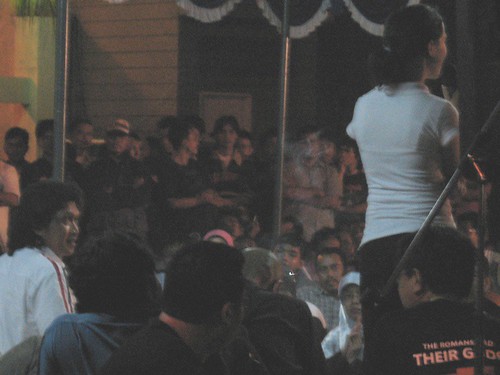
Emha (white shirt, left) & DCK at the microphone in Jakarta
T-shirt on the right reads: 'The Romans had their gods...'

He might like DCK, but it’s well known that Emha is no fan of America. The word “America” came up a lot all evening. HOWEVER, I couldn’t help but notice that Emha had now flanked himself with a fawning Brit & a very pretty, bona fide American, both hanging on his words. No coincidence, that. His street creds had just shot sky high.

It’s clear why many people are here. For one, they’re brimming with the ideals of a young democracy (recall Indonesia made its own transition from dictatorship to democracy in 1999), & they want to be part of making their country work. There’s a lot of frustration with the ways their own newly decentralized government is struggling.

Also, many are dismayed at the image of Islam on the world stage, feeling themselves grouped by association with terrorists. They're eager to show by their efforts that Islam--real Islam--is a genuinely higher path. To remain uninvolved is to give the violent images unrivaled reign.

“Islam,” one tremulously earnest audience member on his turn with the microphone informed us Americans: “Islam is a religion of peace. Thank you.” Then sat down.

We all want to be good citizens of our respective countries. We want to make things better in the world, but at the end of the day that’s a hopelessly vague desire. How can we be constructive when the people making headlines are the people setting bombs? How can we be active when the world is this big & complicated? We are looking for leaders---for heroes---in a world where a hero’s perfection is both required & impossible.

Not that Emha is giving them much of a roadmap. This is a democratic gathering, remember. He’s intentionally avoiding the dictator-father figure, who tells us children what to do. Much as we might appreciate it.

These gatherings are more like revivals, energizing a generation to ‘be involved’. Whatever I’m idly conjecturing about Emha’s motives in putting DKC on the spot (which he has done & she has obliged many times before) (“Once he made me dance,” she said), I suspect it does do some good letting people see & hear an actual, unpolished, Christian American.

If seeing smiling & laughing crowds of politicized young Muslims is rare for us, consider how rare it is for Indonesians to see a hip young American on the spot, one who has taken the trouble not only to come here, but to learn their language, to know their songs & heroes, & now to address them as regular people with a common interest, endorsing their free & democratic gathering.

It didn’t really matter what she said or how nervous & halting she was, or that in her stage fright she lost her Indonesian & the British biographer had to translate; just being there at all meant a lot.

Still, people also wanted to hear what she had to say. After all: everyone knows Americans are godless free-love imperialists who overthrow governments because we love oil & hate Islam, which is equivalent to saying we hate morality. Right? So no pressure. People are just a little curious about those stories, if nothing stronger. But they wanted her to hear them, too. They want to tell an American, & by extension America, things like: I am not a terrorist.
The silence for her was extra intense.

After prodding her to comment on local & global politics & religion for an achingly long time, Emha turned her straight over to questions from the audience.

The very first question was an old, indignant koan from the 1950s, essentially asking this: Indonesia is poor in technology, but rich in spirituality. It has a deep, religious understanding of how important it is to strive for a place in the afterlife. America is technology-rich but spiritually poor. Could she account for that? Did anyone in America give any thought to the afterlife, what with all our riches & holier-than-thou technology?

Hmm....

"I'm really glad you asked that," she began, stalling to collect her thoughts. Back in the day, DCK had been tracked to become a Lutheran minister. She emphasized for the audience—as a positive—that in fact America is a VERY Christian country & much more religious than people in Indonesia realize. George Bush himself, she continued, is a deeply religious man & openly concerned with the afterlife. And so forth.

All things considered, she handled it pretty well. I have to confess, though: I’d never thought of those as reassuring facts, to say nothing of ones I might offer to a Muslim crowd.

No Harm Will Come


The ideals at work here are admirable, but as the British interpreter warned us at the start: be careful. All kinds of people show up at these gatherings & not everyone is altruistic or peaceful. Emha’s dislike of America might be rhetorical & progressive, but for others it’s militant. The interpreter warned us to keep our eyes open while we were in the crowd.

I did. For a little while. Then people kept laughing & DCK got the microphone & I kind of forgot about all that.

When DCK finally left the stage, well over an hour later, Emha—in Indonesian & English—gave her his personal benediction & a careful, instructive guarantee that no harm would come to her at this gathering.

No harm would come to her? I sat up & looked around. The whole gathering snapped into a new focus. All of sudden I had to remember that even here I might be a target because of my nationality. The stage is always much bigger than the one in lights. Sometimes I forget that I'm on it, too.

Right on this cue, 2 young Muslim guys approached me on the outskirts, in the dark, & asked if I was an American. It was about 1 am. Then, as sheepishly as can be, they asked if I would please practice English with them.

One kafir liberal to another? Things like this are signs. When you receive such a sign, it is important to say yes.

I had a map of the US in my calendar & they excitedly drew a map of Indonesia in my notebook. We talked in simple language about our homes. When one drew a circle inside the blob representing the island of Sumatra, I said: “Lake Toba!” (a place I’d very much hoped to visit) & all by itself this made his day. He was so happy. He couldn’t believe it: an American knew lake Toba, his home.

Even such simple exchanges do something good in the world, I think. It’s not enough to change the course of history, but maybe it’s enough to change some minds. Tonight anyway, 3 more of us told good stories about the others' kind.

DCK was in fact gently mobbed afterwards, but only by cautious guys who wanted her autograph (& phone number), & to take her picture with their phone cameras as the famous American who knew Emha. Stars in their eyes.

Being an American is a complicated thing.

IMG_1517.JPG

12 July 2007

Ace Navigation

Many days, I vary my route home in the hopes of discovering something interesting. Things I’d never otherwise find.

This habit also has the effect of getting me lost sometimes (rather often, really), for long, wandering periods of time, as I have a truly lamentable sense of direction. Resistant to improvement, I’ve adapted to this by cultivating an enthusiasm for exploring new places. And a tendency to carry food & water with me wherever I go. I hold fast to Buckaroo Bonzai’s koan:

“Wherever you go, there you are.”


IMG_2561.JPG

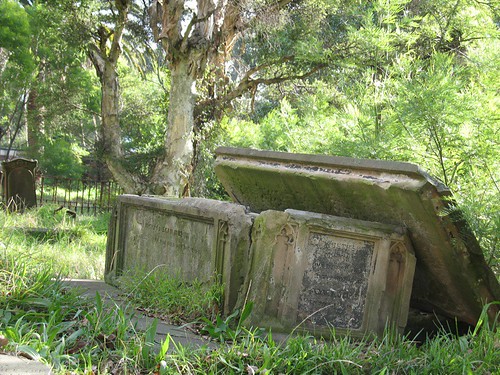
On one such wander, I happened upon a fantastic old cemetery in the green shade of ancient Morton bay fig trees (above). The headstones are all rust-weeping native sandstone furred over with green moss & orange lichen. The very first grave I stooped to read belonged to a William Dawes.

Lieutenant William Dawes? I rocked back on my heels. No. It can’t be. Although it could.... William Dawes was there—here—when my characters arrived in 1790. He was among the cleverest, kindest officers of the first fleet, the astronomer & ace navigator who worked at his observatory on Dawes Point (a magical promontory now supporting one foot of the Harbour Bridge). The date...well, the date on the stone is hard to read, but what I can make out is not strictly impossible...is it?

There isn’t a whole lot written about Dawes—he didn’t keep a surviving journal of his own—so he can float unqualified & unstained by detail in the few anecdotes & lovely adjectives that other officers ascribed to him in their journals. He was smart, deeply moral, & one of the only people that everyone seemed to like.

More interestingly, though, Dawes compiled a short lexicon of Aboriginal words, among the first ever. He did this with a native woman, Patye, who was his companion & probably his lover. It looks complied incidentally, rather than methodically. That's to say, he didn’t go at it from A to Z, or in order of military importance, or with a specific agenda. He seems to have recorded words, phrases & concepts as he learned them from her, as they naturally came up between them.

So you do get an unintentional, telegraphic sort of journal, a list that preserves the tone & subjects of their interactions, which are sometimes funny, coy or curt, occasionally lovely, & ultimately touching. My favorite—though I don’t have the text in front of me & so can’t quote it—is a native word describing some aspect of this: warming another’s chilled fingers by heating your own hands at the fire & then gently clasping theirs.

Oddly, I feel as if I know this man a little, maybe in the way you come to know characters of great novels. So here I’ve lost & then found myself in Dawes' old hiking grounds (now an urban center), wandered into the green graves around a corner, & suddenly: his headstone. This is a sign, I say to myself. A great & worthy sign.

We aren't so complicated really: all I need is good food & exercise, fresh air & social contact, the time & peace to do my work, & highly symbolic chance encounters with 200 year old intimates to sustain me. Basic mammalian stuff.

IMG_2589.JPG

Epilogue

Of course none of it is true.
For when I snap out of it the next day—one of the librarians in my deepest brain cells shoots up a cranky note via pneumatic tube to my conscious awareness—I know this just can’t be right. Thinking about him doesn't summon him like this. Wanting that 6 to be a 2 doesn't make it so. It's got to be another William Dawes. So I go back. And it is. For one thing: my Dawes was buried in Europe. This is some other guy of the same name & century, maybe someone with a great story, too, but I don’t know him at all.

Still, I enjoyed the mistaken delight while it lasted.

My Neighborhood

People have asked me for nittier-grittier details concerning what’s it like where I’m living in Australia.

For 5 weeks I've rented a bright studio apartment in the Newtown area of Sydney. Nothing fancy, it’s a perfect landing pad: a place to write, sleep, store my gear & wash up between events. Through the sliding glass door, the balcony has a view of a mellow parking lot, the flag of Scotland (on a castle-like university library) & two sycamore trees where lonely crows sit & bawl.

The Newtown neighborhood is ideal for me. Near the University of Sydney, Carillon Avenue is right off King Street, which is happily bustling every night of the week til 2 am. I can walk to the bus, the train, a movie theatre & all sorts of bookshops, vintage clothiers, bottle shops (=liquor stores), cafes & great restaurants.

Bookstores like: Better Read than Dead.
Sushi joints called: Eat Me Sushi.
(my favorite was a Jakarta Mexican restaurant called: Nacho Mama)

When I work alone all day & don't know anyone in town, it's good to be in an area with a lot of people & social businesses close at hand. Even being alone in a crowd, I prefer a happy crowd sometimes. The streets throng with students & hip adults. There are white homeless men panhandling (unimaginable in Jakarta). Some punks. Plenty of tattoos & piercings. Big dogs. Vegans. Young professionals in black coats. Restaurants & cafes tended to throw doors & all their front windows wide open; you just wear your coats inside.

Campos

Campos coffee is around the corner. Here, for black coffee you order a Long Black, but most people order what’s called a Flat White, which differs from a latte, I’m told, in that it’s slightly less fluffy on top. Campos makes a truly splendid coffee with artful ‘leaves’ swirling every lidless foam. Inside it’s packed & the guys working there are not your average baristas. They’re adults for one & consummate professionals: always working at full tilt, always pleasant, but with the attitude of serious craftsmen. I don’t know why that matters, but it works on me.

IMG_2906.JPG

Durable Goods

I came with 2 suitcases & 2 carry on bags. Upon arrival, I finally unpacked the set of gloves, wool socks & the sweater I’ve been carrying for 5 months. In Sydney I added a wool coat & hat, & 50kg of books, which I shipped back. I wear the same pair of jeans & hikers just about every day for 5 weeks, as everything I else from Indonesia is too light.

I have a little desk for my laptop, an internet connection, a frying pan, 6 eggs & a hotpot. Life is good.

The Weather


Most days it was about 60 F & rained often. In fact, there were bad storms & floods while I was there (which did NOT happen after the Second Fleet arrived here in June 1790. The weather was off script!), which drought-ridden Australia welcomed.

Some days I walked through a green park, where people walked dogs & lorikeets cheetered in the eucalypts, to attend an early morning yoga class. I had to get up early (for me) because—for my one shiver of winter this year—it got dark at 5 pm.

Relaxing to Violence

My studio had a TV featuring 5 channels of hideous violent crime: local & world news violence; hospital drama violence; police drama violence; courtroom drama violence; & forensics investigator violence, all of whose protagonists--& I’m including the news reporters here--are brilliant, beautiful but 'quirky', misunderstood, fighting the good fight & tragically screwed up. Ah, the West. Nothing like a solid American explosion or six to cap a day of researching a penal colony.

Some nights, brimming with the violence I’ve done to my own characters, I can’t watch any of these 5 channels. At those moments all I can take is a Saturday morning special. Even lorikeets squabbling in the trees can be too much. I lean out on the balcony & plead with them to stop fighting. Just work it out, you birds. Can't we all just get along?

Some nights, after hearing the latest shaken policeman / lawyer / pathologist / news anchor remark, yet again, that he's NEVER seen ANY crime this HEINOUS in his WHOLE CAREER...I just want have a drink, cry through some happy kids’ movie about ponies, & sleep soundly.

And then write a book about about blowing bubbles in the park.

11 July 2007

Perils of Detail


IN 1999 I wrote this sentence for a short story I was thinking about, called The Lime Tree:

“On the seventh day out from Portsmouth, in the brig of the prison hulk Wotworth, I began to forge the second coin from the handle of a spoon.”

I flat-out loved this sentence. It was a little magisterial, but I thought it had read-aloud rhythm. It had action, tension & the promise of more. It had neat words like hulk & brig, & strong verbs like forge. We were already set in a floating prison, which is a reliably dramatic, even melodramatic, setting. The fact that it’s a 2nd coin suggested there was a first forged coin, which a clever reader might suppose had something to do with the narrator being in a prison hulk now. These are things I only notice afterwards.
They seemed like honest virtues.

Better yet, it happened. A first fleet convict bound for New South Wales, a fellow named Thomas Barrett, did in fact forge coins from pewter spoons on board the ship. Maybe not on the Biblical seventh day, that I made up, though he could have. I switched it to the Second Fleet & a different forger. The Wotworth is a fictional ship. But the bones of it are real, which to me makes it stronger still.

Then I wrote some more, did some research & found things like this:

• Revision of the story required me to shift the forgery a few weeks into the journey. So I lost “the seventh day”.

• The 2nd fleet set sail from Stokes Bay, so I lost Portsmouth. (Only later did I realize that Stokes Bay is part of Portsmouth Harbor, so I got it back).

• A HULK is a floating prison, but not a sea-worthy vessel. Prisoners were kept in hulks in the harbour, but they were transported to NSW on ships called Transports. So I can’t use the word hulk.

• To call it a BRIG may not even be correct. These ships were converted to have cell decks or areas, but they didn’t tend to call them brigs. So brig was out, too.

• I found lots of interesting, incomprehensible slang words for coins: like George (the king, whose head was on coins), Brummagem button, or grunter. Forgers were called smashers or bit-culls.

• Look closely at those pewter spoons up there. Or any spoon. Which end would you use to forge a coin: the handle?? No reader has ever commented on that choice, yet once I noticed it, it had to go.

The technically corrected sentence would have nothing whatsoever going for it:

“A few weeks out from Stokes Bay, on the converted cell deck of the prison transport ship Wotworth, I began to forge the second Brummagem button from the nice, coin-like round part of a pewter spoon, as any sensible bit-cull would.”

So I had to cut it. What do they call that in school? “Kill your darlings.” In the end, it's better for everyone involved. Onward to greater struggles.

Guys with Giles Guile

22 June

ON a 5km coastal walk from Bondi to Coogee beaches, I lingered at the Giles Baths rockpool to watch the boys jump.

The Giles rockpool is a brilliant natural bowl at the northern tip of Coogee beach. At the base of dark cliffs, the rocks provide a nearly circular wave break & a rough pool the size of a house. A steep set of stairs runs down to it. Adults pause at the rail above to watch.

Skinny 13 or 14 year old boys in black wet-suits perch at the ocean-side rim & hurl themselves into the water exactly as a choice wave smacks the rock, exploding upwards, & then fills the bowl with a turbulent cream. The jumper’s head breaks to the surface again like an otter’s & he paddles up to do it again, about as happy as youth can be.

Rockpools are one of these minor wonders that makes me happy to be a human. Because if there exists a rockpool with exploding waves, then people will hurl themselves into it. This is axiomatic. Just as people will climb on unusual cliffs, rooftops & chairlift towers, even though it’s dangerous & there’s nothing up there. No amount of dire warning signs will stop people from doing this. It’s just what we do: if it’s fun, we’ll play on it.

It was here that I overheard a perfect moment of early manhood.

When the 3 otter-boys tired of jumping into the bowl from the rim they shivered up the steps & leapt from the various ledges above it. These were still a little ways down from us onlookers, some of them out of sight entirely. Being directly down from me, the jumps were riveting as the boys would simply disappear over the side to what looked like certain death by dashing against hidden rocks below.

This was their pool, though. Up close I could see beneath their goosebumps that they were leanly muscled & sun-bleached: they did this all the time. Their suits were well-worn. This was their childhood delight. Sure enough, a too-long moment later they’d bob out into the bowl & wiggle right back up the steps to jump again.

Then one time, all at once, they spy another boy at the top.

This new boy is the same height as they are, but he’s crossed over: conspicuously broader in the shoulder & jaw, ruinously handsome & confident in the way of a benevolent alpha. To their adolescent skinny, this new boy is comfortably tanned & muscled from surfing & swimming in the ocean. To their plastered-down kid hair, his mop has an intentional cut & style. More, he’s not wearing a wetsuit. He’s dry &—in a ballsy defiance of winter—wearing nothing but cool, red swim trunks. He does not have goose bumps.

The otter-boys approach this new kid as if summoned, as if drawn by magnets, wearing slack expressions of awe. This is their pool in some way & if this new kid were just a year younger, I think their gang might lay down some laws. But this—they can’t compete with this. They stand with their arms limp & their toes together, blinking. Suddenly their black wetsuits seem excessive, maybe something their mother made them wear to keep warm out there, honey, with all those big waves.

Slightly agape, they wait for him to address them. Or to do something amazing, something only kids who need razors can do. Gracious in his superiority, red-trunks only glances over the side here & there—so casual—as if for a place to jump. No, exactly for a place to jump. From HERE.

Red-trunks has drawn them up to the grassy flat part of the cliff, directly opposite the observation rail, where I’m standing. It’s much higher here—death-defyingly higher. It doesn’t take but a glance to know that our 3 otter-boys have never even considered jumping from here.

“Is it cold?” asks Red-Trunks, flattering them by asking. His voice has broken, too.

“Uh. No,” pipes an otter, trying to sound off-hand & cool. “It’s not bad.” Then again, he’s not mostly naked.

“All right,” nods Red-Trunks & without a second’s hesitation, flits right off the cliff. He flew. He levitated. I saw it. He just glanced down, raised his arms & vlip! The kid was gone. I didn’t see him again.

Now the otter boys are left standing there with their knees locked. They don’t move. They don’t speak. They exchange nervous glances. Their future has been written & not by them. Then one of them, nicely summing it up for all 3, says simply: “Fuck.”

They all nod at the rightness & profundity of this. Then, one by one, with no alternative, they throw themselves over the cliff.

09 July 2007

Epilogue to Frog Porridge

A confession:

Over the course of this trip I dined on some extraordinary dishes. Some delicious feasts (Jumbo Seafood in Singapore, near Clarke Quay). A few items I don’t ever need to eat again (bad laksa; marmite chicken; frogs; avocado coffee). Some tasty foods I’d never expected to like (durian, frogs, tea eggs). Some fruits I’d like to eat all the time (mangosteen, snakeskin fruit, rambutan, mango & chili salad). A few dishes I liked a lot but ate altogether too often (fried rice with ikan asin (dried fish bits); noodle soup) And many things I’d never tried before.

The funny part of this culinary adventure—maybe something I shouldn’t admit—is that the very most delicious thing I’ve eaten so far this year was a fresh, gourmet, chicken pot pie that I bought in the Plaza Indonesia mall, at the central café, as a snack.

Chicken pot pie was one of my favorite foods as a child. That mall pie was the best one I’ve ever had. The irony only made it more savory still.

So you see, it hardly matters how far you roam or what you try. All of a sudden, the scent of something you loved at 9 years old can sneak up & lead you right back to where you started.

Inside-Out Fever

People at home ask me: During our 5 & 6 months in southeast Asia, did we ever get sick?

Yes.

When we left, there was no recommendation of special shots or pills to take in advance for Indonesia. We washed our hands often. Many public spaces (such as restaurants & temples) have hand-washing sinks right there in the main rooms. I kept hand sanitizer gel in my purse & a big bottle of it on the kitchen counter: the first thing we did whenever we returned home was squirt that over our hands. We drank bottled water & took some care not to eat foods involving unboiled water.

Thankfully, we did not contract malaria, dengue, yellow or typhoid fever, typhus, bird flu, or any other serious tropical disease that once made these ports such catastrophically mortal hazards, & trouble the country still. We stayed away from the flooded areas as best we could, where people were starting to see water-related disease.

A big public awareness campaign against malaria focused on getting people to bury plastic containers in the ground (vs. leaving them on the ground)...so that these didn't collect water & become breeding grounds for disease-carrying mosquitoes.

For generally healthy people, however, we did get sick often: about once a month, but nothing serious.

The plane trip to Jakarta landed both of us with bad colds. Vectors of water, food, children, pollution, hexes & germs all contributed to a well-rounded experience of minor knock-outs. What I came to call Inside-out Fever wrung me out twice. What is that? I suspect it's a kind of food poisoning. Imagine your body making a heated, 36-hour attempt to expel your insides, all at once.

Some fun, eh? For the most part we were just fine. Everything cleared up the day I landed in Singapore. Because the Singaporeans have gone at food standards, disease & pollution with the law of hammer & tongs. They mean business.

08 July 2007

Dross

When I think about what I would do, were I a mega-wealthy, gifted statesman in Indonesia, I often think about garbage.

With 12 million residents in Jakarta, there’s a lot of it here & no regular or well-regulated system of disposal. I think to garbage not just because it’s right in front of me, but also because unlike the even more complicated & exciting issues at hand today (like mud volcanoes, corruption, the national airlines & trains crashing, the challenges of a recently decentralized government in an enormous, highly diverse country laid out on a series of islands, or division of mosque & state), fixing the GARBAGE problem seems possible & only good. This might one of those universal issues that everyone could support.

No? This isn't Singapore with its fleet of elderly scrubbing the curbsides with toothbrushes. So far Indonesian garbage seems redolent of everything BUT a business opportunity. So long as disease is not rampant, it isn't a paying priority. What's in place works well enough.

You’d at least have to, what, assemble some public & private bins, people to collect it, equipped trucks & drivers, train everyone & create a culture of making use of all this (maybe some laws against littering once the system is in place). And, of course, you'd need a huge place to put it all. If only it were that simple. Because there are high costs & many hazardous things that people dump, diseases would probably play a role, & then there’s the mysterious science of dumping.

The Science of Dumping

I read in the papers about someone who did take this as an opportunity of sorts. His family decided to let people use their back yard as a dump. This worked out just fine for years—people paid him to dump their things, his family made some money, the neighborhood was that much cleaner—until one day a towering wall of garbage came down like an avalanche & killed people.

Now, much of Jakarta does have regular garbage service of course—this is a functioning, international metropolis, after all, the business districts are no dirtier than some US cities, & the malls can as lavish & familiar as they come—just not everywhere & never enough. I’ve seen people peeing, bathing & throwing their garbage into the brown river right here in the city, in broad daylight. I’ve seen a guy exit his house to the street’s edge, swing a white plastic bag around & around, & then whoop! lob it right over the edge, where it opened in mid-air & scattered all his rubbish & slop into the water below.

On the eastern island of Sulawesi, Fulbrighter istri (wife) EJM & her husband actually paid someone to motorcycle their household garbage into town, to a trash bin. There was no where else to put it. They were trying to do the right thing. Then one day they caught sight of a certain cereal box in the river & knew at once that it was theirs. They were standing on a little bridge looking down to places where no one should climb. They couldn’t retrieve it. To do so would be almost meaningless anyway: there was garbage everywhere.

Even so, there they were on this bridge in Tana Toraja suddenly recognizing their own personal waste amongst it all, their own distinctive splat of squalor on this foreign riverbank, their drinking water lapping at it.

Consider what it would take—& what it would require you to do differently—for that to be possible for you where you are now, that is: for someone to motorcycle your household garbage into the next town (or the nearest river) for disposal. You’d probably have to produce a lot less garbage for one thing.

IMG_1573.JPG
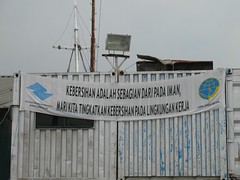
"Cleanliness is Part of Faith
Let's Increase Cleanliness in the Work Environment"
sign at the Sunda Kelapa pier

07 July 2007

A Dream: Awake

14 June 2007

Last night I dreamed of leaving this world for the next.
Something about helping to re-join the long-separated shards of Man & moving on to the next evolution in consciousness. Hindu? More likely a lost memory of The Dark Crystal. I was excited about this. I was ready. I wanted to help.

With some sense of imminent doom to this world, now seemed the time to go. I made my good-byes, walked across a field to a little white annex room with a door, & shut it behind me.
The world was gone.

Inside I found a small office with a slightly alien woman behind the desk. What was it, her mouth? Its cut across her face unnaturally large? She was a bureaucrat but friendly enough. A little frumpy. She pulled out a series of forms & began an interview to see if in fact I was serious & willing to make this transition.

For awhile, I believed that I was. I started to sign things.

Then it became clear that what was going to happen was that I would literally be reincarnated as a newborn infant on a new world, a journey that seemed less & less like a true evolution of spirit, than simply starting over in a different, more alien society. Yet this society had some wholly familiar & mundane appetites. The secretary couldn't promise who my parents would be, she explained, but all the candidates had applied for a baby & had been vetted as truly wanting one.

For the first time I began to think about what my interviewer's motives really were.

There was a current fashion, she felt it fair to warn me, all the rage, really, but nothing to fear, of some (but not all!) parents using hormone technology to keep their children's bodies around 18 to 24 months of age until they were ready to leave home, at which point they'd be rapidly grown, straight through puberty & to adulthood, which sometimes had its complications.

She handed me a set of worn, soft-bound notebooks. They were unfamiliar. I flipped through them. They contained pasted-in photos, drawings & handwritten journal entries that were my own, as well as many pages of photos & journals interleaved by someone else. Someone who liked to keep rather anal lists of unimportant things. The blending begins. I was going to be the different-than-we-expected part of someone's made-to-order baby.

I lost my conviction—a dropped rag. Thin rationalizations sprouted up in its place. Well, I can't see the whole picture from here, I reasoned, best not to judge it yet. Well, this is all just to test my resolve. Well, who's to say the soul's greatest work isn't there, & achieved through that very suffering? Which made me wonder why that wasn't just as easily achieved here.

Turning the pages, I found myself looking at old photos from my childhood, photos I've never seen. Candid, wonderful snapshots of family, of Yosemite gatherings, of Girl Scouts, of good friends, of Evan—I began to feel a powerful, visceral love lift off the pages from my life in this world.

I saw my family in intricate detail from above, watched families I'd grown up with laughing together, overhearing years of verbatim conversations, which passed in split seconds like birds past a window. I saw E and E and E again, & felt this great love grow like a tree through my body & limbs & through my head. I glimpsed the true form of my love, more whole & real than anything else I knew. The gift of it was so patent, so beautiful & rare, that all at once I could not bear to leave it. I doubted I would ever find this much again by rolling the dice like this. To give up on any of it, on any person or part of this world, or on this great, lucky true love before my life had run its full course was utterly unbearable.

Without realizing it, I'd begun to talk. I was telling the secretary anecdotes of the people I was seeing in the journals & in my mind's wide-open eye. I was telling her in that urgent way I have, when I really want someone to understand exactly as I understand it. But these were not good stories of the sort I'd tell to engage a group for fun. These were details that only meant things to me, not stories at all but human instants, emotional touchstones, & I had literally bored the secretary to sleep.

She was slumped in her chair, blouse rumpled & glasses crooked, her froggy mouth open & drooling a little. I didn't know how much time had passed. I had my doubts still. I wasn't convinced how useful I'd been with my life. Or whether these feelings were simply self-indulgent, delaying greater works. But I didn't care so much about that anymore. I knew truth when I saw it & I knew what I believed in. Whether she was faking the sleep for my benefit or if she was really out, I took my chance & slipped back out through the door.

It opened to a different place than where I'd left.

So I began to make my way back Home—to the people & grounds that had seeded that love—through an Odyssey of new dreams & chains of events, hundreds of new people, wild sexual encounters, of battles that passed in instants, & one expansive moment comforting a lost childhood friend, removing her shoes & stroking her back, herself curled on a bench at some lonely train station, sad for reasons beyond my understanding. Of long voyages.

When I woke at last, surfacing to that still pond of the morning mind, it was with the pleasure of a choice rightly made. Maybe I did it after all, I thought. Maybe I did leave this world for the next: the same world but awake. The same world more clearly seen & better chosen, steadily seeking my way back to you.

05 July 2007

The South-East's West

With Sydney I returned to a culture altogether familiar. I might not speak Strine (‘Australian’), but I speak Western. Australia may be in Southeast Asia, conscious of China’s looming shadow, but it is ‘the West’.

I was sometimes a little lonesome, but I wasn’t culture shocked. Part of what softened that blow was starting the transition in high-tech, English-speaking Singapore. Part of it was the fact that I lived in a studio apartment even more spare than our Jakarta digs (a fine thing). I was usually alone, too, so the social cultural adjustment was more gradual. Finally: with the Writer’s Festival running me 7 AM til midnight for the first week, I hit the ground running. There wasn’t time for much shock.

For the moment, I’ll just list the most simple & striking experiential differences between Jakarta & Sydney, more or less as they occurred to me:

Height. Suddenly a huge number of people are 6’ tall or taller. Women, too; at 5’8” I was again looking people directly in the eye--or up.

Hair! Poof! Now this magnificent, voluminous variety of hair colors, textures & styles. With all the punks, this includes a frequent appearance of the full rainbow, too. Men & women both: long dred-locks; tall Mohawks; tight curls; frizzy red-heads; afros; shaved bald; honey-blondes; aqua! crimson! green! Words carved into buzz-cuts! Seashells, beads, yard, metal bits like a crow’s nest of shiny plunder woven into giant mats or strings or braids or tails of HAIR.

• It’s cold! Wonderful, blessed cold. And dry.

• Second hand book stores & coffee shops occupy every corner of my neighborhood!

Blue sky

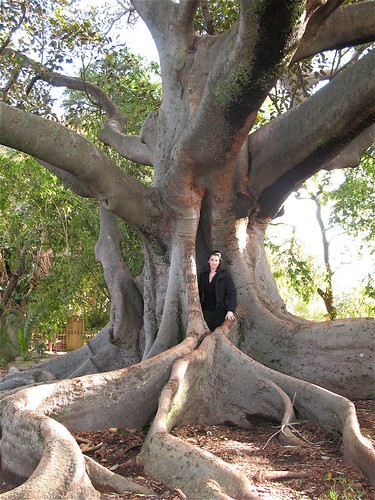
Noses. White people have huge, fin-like bridged noses. Like Morton bay fig roots:

IMG_2208.JPG

• My pollution-cough is completely gone.

• There's a drought here, but tap water is potable, & it tastes really good.

Crowds. There’s less of a natural flow to packed crowds here. Sydney-siders walk as unrelated individuals, rather than joining the organic flow describing Indonesian traffic & crowd patterns. On the one hand: there are clear, abided laws. On the other hand, many of these people would be hit by bajai.

Fast pace & it’s contagious. Everyone’s walking, too, & expects me to be walking, & walks fast or at least purposefully.

Long Distances by foot. When I ask for directions, the people I’ve met—old, young, rich, poor, men, women—think absolutely nothing of sending me off on a half-hour (or longer) walk.

• It’s a cliché of Australians, but the open friendliness & ease of people on the street was tangible & made traveling around pleasant. I felt a distinct lack of weary crankiness or wounded dignity (only demeaning myself at this café / shop / counter until graduation or my ship comes in type attitude) behind the counter. At a first take, strangers here strike me as less suspicious than Americans, more talkative & genial than Indonesians (who are maybe much more polite in general but rarely addressing customers first or so forcefully, as equals).

• A secular country! Comparatively, there's almost NO religious signs anywhere…& I hear a palpable, conscious public voice of not being associated with any religion. Yet later: also the clear presence of mega-churches in the outskirts & the arrival of American-brand evangelical, extreme Christianity. More on this to follow.

• All white audiences

• Slow Food; Vegetarian & Vegan food; Sustainably Grown, Fair Trade, locally grown, Cage Free Eggs, Hormone & pesticide free everything…everywhere. There were 6 organic & 5 vegetarian restaurants within four blocks of my studio.

• Ecological awareness & organized conservation. All sorts of people carry those reusable green eco-tote bags. I'd see a couple dozen a day. Recycling. Good public transportation (compared to Indonesia & the US). Water conservation. Even the Writer's Festival boasted being "carbon neutral", off-setting all the fuel costs of electricity & travel costs for the week-long conference.

Sycamore & eucalyptus instead of palms or flame of the forest

Crows & lorikeets, instead of bats & swallows.

• I can go running again: it's cool enough, clean enough, flat enough, & there are places without traffic.

Traffic lights! Indonesia often uses one-way streets & long turnabouts instead of traffic lights, causing some routes by car to be far longer & more circuitous than walking. Running traffic lights may be more expensive...I’m not sure why Jakarta doesn’t use many.

Bread. Bread is making inroads into Indonesia, especially in places where refrigeration is more affordable (or: afforded) & common, but there’s still not much & little that’s good. That’s one factoid people tend to know, & knowingly brandish, about life in the United States: Americans eat bread.

• In terms of sheer visible numbers, men in Sydney (& in the US, as I recall) don’t hold or care for babies & children in public spaces so much as they do in Jakarta, where the job would appear almost evenly split.

• The coffee is good. At home in Minnesota, we like Indonesian coffee. In Indonesia, the coffee was usually pretty poor & as or more expensive than US prices. Coffee often cost more than the entire meal. I’ll tell you about my favorite Sydney café, Campos, in a bit.

Silence. In a city of 4.3 million people, I slept—God be praised—to silence all night long.

Uncensored political protest & outrage. One thing I’ve always thought was a great genius of the US, is our government’s general tendency to ignore people, groups & shows that criticize it. I’m not suggesting our government doesn’t & hasn’t censored many things, but there is a freedom of expression that's quite patent in the west. This happens even at the level of an angry person standing on a corner all day (as there were in my Sydney neighborhood) handing out fliers to rallies, putting up posters, publishing articles, passing around petitions, & saying all sorts of hateful things—true or not—about the Australian government (& the US government. Often & at length) without fear of reprisals. You might find what they have to shout silly, but they MAY do it. In Syria, in Singapore, in Indonesia, every word of such objections can be very dangerous acts.

In Jakarta we described the Daily Show & Colbert Report to some Indonesian students in a discussion of American humor. They were speechless at the fact that these weren’t censored & their creators had never been arrested for their content.

Many good & strange things here. It's a pleasure, if nothing else, to reacquaint myself with the concept of WINTER.

Looking at that list, I can see that for all I've enjoyed, appreciated & learned in Indonesia, I am also glad to be back in familiar terrain.

29 June 2007

Spelling Birds


In my first week, I thought I'd start off simple.
With a sort of writing exercise.

I'd just read a book by Australian author Kate Grenville, The Idea of Perfection, in which she'd spelled out birdsong as the characters heard them. She did it a lot. Too-wee! or Weet! Weet! Weet! Things like this. A simple enough device. It gives some sensory depth to a scene. For the rare birder in the audience, it might ever offer some particular delight in recognizing a call.

Now I don't know if I'll actually do this in my own book or not, but either way, as I was going through my day, I decided to pay particular attention to local birdsong & take phonetic dictation for whatever the birds said. Just as Grenville did. Phonetic spellings. I carry a little notebook with me wherever I go for just such endeavors. Then, at least, I'd have a list of such details should I wish to use them.

So I step outside into the bright winter sun, the sky a clear blue above, & listen. Nothing. Mild traffic sounds. A breeze through the sycamore. I start to walk.

Pretty soon I come to a stand of gum trees along the road & there in the highest branches are a half dozen rainbow lorikeets. Beautiful, manic bird, who love to hang upside-down & swing about. Whistling.

I pull out my pen...but I'm not sure how to spell this. In fact, I can't spell whistles. Sometimes lorikeets make spellable sounds. They go: Bleep! They go: Wheet! But right now, they're just whistling. More, they're all whistling their own individual tune at once, very rapidly up & down their high scale. So rapidly that, even if I were to spell it out, the rate at which you'd be able to read the phonemes on the page would be far too slow to be accurate. It would just be annoying.

Okay, so that was too hard. I would come back to them. I moved on.

IMG_2389.JPG

It was the 190th anniversary of the Hyde Park Barracks. The museum had brought in a bunch of re-creationists in costume to celebrate. They'd set up booths demonstrating period crafts & tortures in the courtyard. I spent a long time with an enthusiastic "18th century" surgeon in his leather apron demonstrating surgeries. He let me rummage through his medicine trunk. I picked out a leaden glass jar of mercury--supernaturally silver & too heavy--which we once put by drops under our tongues & smeared in salves on our tricky bits to treat venereal disease. These were the days before anesthetic. He told me about a nearly spiritual rapport between surgeon & patient that some period doctors termed
"The Rights of Pain." He handed me a bone saw & directed me to 'cut off' a volunteer's leg. Be swift, he advised. Be pitiless to his screams. For the sake of your patient: swift & pitiless.


But more on that later. Right now, I'm trying to spell the birds.

Outside the barracks, a crew of red-coated marines were going through drills for a crowd. From a 'cell' on the second story, I opened a window just in time to hear them shoot a volley with muskets. Big blue plumes of smoke for every shot. At the first shot: a big flock of white cockatoo exploded from a tree & made a low pass over the courtyard....strafing the ground with their calls. People actually ducked. They sounded like Godzilla.

Exactly like mini Godzillas. Deafening, raucous, chord-splitting cries with a little yodel underneath. Can you spell that? I can't spell that. Any attempt would only be foolish.

Sometimes cockatoo say: WRECK! With a broken, rough voice & drawing out the short "e". They say it loudly & often enough that sailors must have hated them as bad luck. Wreck! Wreck! But this time, at the barracks, a flock of cockatoos' full-throated cries maybe sounded like Tarzan's call combine with a caught-chicken. But I can't make those comparisons, of course, because neither Godzilla nor Tarzan were around in the 18th century.

I had nothing.

Okay, so I went to the botanical gardens. The big white ibis, with its unmoisterized naked head & a long, down-curving beak that's tempting to grab hold of when the cheeky buggers walk up hoping you'll feed them---they say nothing. Or, they held their peace for me. Also, they weren't here in 1790. Neither were the 9 thousand flying fox killing trees in the Domain, who can sound like 9 thousand squabbling siblings up there, all poking & objecting & calling for mom's justice. But again: they weren't there. And I can't spell that sound either.

IMG_2152.JPG

On a tour of the flora, I met an intentionally homeless man, a red-haired rogue sort calling himself Damien, who claimed to be studying 'revelation through hardship.' I buy this guy lunch because he sounds interesting & we talk (about his) cosmology for an hour or so. He believes in a circular, endless reincarnation, beginning with dirt, & has a theory about men & women's souls. He's writing a book, he says, called "Damien Challenges Satan". He's just spent a month at a Buddhist ashram in the hills & lets the crows eat our crumbs when we're through in a gesture of Love to All Creatures.

While we're talking, a man with a green parrot on his shoulder stops to look at the silent ibis at our ankles. We look up at the man with the green parrot & say hi. The green parrot looks right at me & says, "Hello!"

Ha! Where's my pen & notepad? H-E-L-L-O!
I can spell THAT. Fantastic. That's one!

All day, the only one I could really spell were the crows. I don't know where Kate Grenville was hanging out, but the birds there clearly speak a different dialect. Or, maybe I'm simply not a good enough speller. (I've always been tragically ungifted at spelling bees. Only makes sense that I seem no better at spelling birds.)

The crows, the sycamores' carnivorous whiners, sound like nasal, nauseous toddlers bawling by themselves, as if without hope for relief: Owww. Bah. Engh. Bau.

A flock of kookaburra--aka The Laughing Jackass bird--can sound just about exactly like monkeys. The stereotype of monkeys: oo! oo! oo! ah! ah! ah! But when they all go together, the group energy of it ramps up & up just like a band of monkeys working themselves up to make a raid, a crowd about to turn mob, until I start to look around thinking maybe I should find shelter. Then the wave of it crests & falls & there's just this one bird: laughing at me for the thought.

The truth is, there's almost nothing here in Sydney that's the same as it was in 1790, though it's been fun trying to read between the lines of the present day. I went to an art exhibit of early landscape paintings made in the earliest years of the colony. "Visions 1788" it was called. When I'm researching fiction, there's something much more satisfying about finding my source images in paintings, rather than in photographs, the latter being somehow too blatant & close. What's left is only available to imagination.

Similarly, there's something wonderful in realizing that the only authentic, unaltered voices that are still around from that period in history are the BIRDS.

Oo! Oo! Oo! Ah! Ah! Ah!

26 June 2007

Parts Unknown Beyond the Sea

Two hundred & seventeen years ago this week the Second Fleet of ships carrying convicted criminals out from England's over-crowded prisons & hulks arrived here, in Sydney Cove.

They called it Port Jackson. New South Wales. The Cumberland Plain. The continent of New Holland, terra australis, the antipodes. It was the land of the Laughing Jackass Bird, now called the kookaburra.
They did not call it Australia.

In 1790 this was a place with no fixed name of its own.

Back home in England & Ireland, people called it Botany Bay.
But that’s 7 miles south of here. Even when this was understood—that Sydney Cove was just a much better location from the start—the papers kept calling it Botany Bay anyway. Those sentenced to exile—to Transportation, as it was called—were officially sent to Parts Unknown Beyond the Sea.”

"Circular Quay" in 1788

Planting flag, 1.1788.bmp

I stand here along a jagged line of bronze disks embedded in the sidewalk around Circular Quay. The disks mark the original shoreline from 1788. I’m trying to imagine what it must have felt like to look at that the northern shore of Port Jackson knowing that there was absolutely no civilization as you understood it anywhere else on the entire continent. Odds are you’re a city boy, not given to walks in the woods. You ain’t never seen anything like this. Odds are you’re a teenager, too. Or barely in your twenties. Maybe you’re sentenced to be here for the rest of your life.

The Second Fleet was the most notorious ever to bring convicts to Australia. It was contracted by a company that ran slaving ships & the masters were paid only for every head that embarked, not for any head to land; almost a third of its convicts died. But not you. Somehow. When the survivors started their lives over again here, they started from death’s door.

There are no bars & few chains. If you wanted to sneak away, you could walk for days, weeks, even months in any direction, walk until you hit the ocean again, & all the way there you’ll find no one but the black wild men who carry spears & clubs like some prehistoric nightmare. It took you 6 months to get here if your ship was speedy & so even if you were inclined to run—to try for “China”, say, as some wiser sorts swear exists 5 days to the north—you’re half starved & badly out of shape. You’ve got scurvy for sure. Frankly, you’ve never been in the woods. And you’ve just seen a spider as big as your hand.

Maybe you’re literate, you might even be brilliantly clever, but you don’t know your geography here, because NO ONE knows the geography of this place. This place hardly even exists on world maps. It’s just the southern land mass that geographers always hypothesized MUST be there, because something had to balance out the land masses in the north!

The Dutch found the west coast. Then Captain Cook found the east. He hauled over, hopped out, took a pee, sniffed the botany, shot a wallaby & declared it a fine land indeed. His buddy made a book of pressed flowers & some awfully nice watercolors of pretty birds that in reality scrawk! at sunrise louder than any dawn rooster. And there are flocks of them.

You’d like to tell Captain Cook to kiss your fine ass indeed, to stick it up his Parts Unknown, this fine land indeed that His Excellency, governor Phillip, claimed for England TWO DAYS before the French arrived & conceded in a gentlemanly handshake that it seemed they’d missed their chance to claim the land for France.

Didn’t that part bode ill? Wasn’t that a little dodgy? That the French—the French—just shrugged, Aw shucks, lads, you beat us, we’ll just pick some flowers & be on our way? Best of luck with the penal colony? Didn’t Governor Phillip wonder at that handshake, just a little? A fine land indeed!

Maybe it didn’t happen quite like that. But you’re this 19 year old guy transported to 14 years Beyond the Sea for receiving a stolen candlestick, or something. Sounds good to you.

In 1788, parts of the country's coastline are still partially guesswork, mapped with dotted lines. On one map the cartographer has very gently described Man's ignorance by smoothly blending the tan-colored north coast into the ocean's blue. No one but the natives have been anywhere but the coasts & you don’t speak their language.

Wilderness looks very different when there’s nothing on the other side. The possibility of getting lost means something different, too. DARK means something different. Weird sounds in the night could mean anything at all. You don’t even recognize the stars; you are on another planet. This morning you heard someone remark that this view across the harbour is beautiful! You’d thought he’d lost his effing mind.

He’d called it Eden, this man.
He’d called the wild men the ‘unfallen’.


So we brought em a penal colony? What, to shove the unfallen over the edge as late-comers to sin, as mere dawdlers? There’s piety! You know Man isn’t supposed to come back to Eden. That’s like trying to climb back inside the womb. If that man is right, then there’s also an angel here set to strike us, for the only thing a sinner’s presence can augur is the Fall.


Of course, I’m eating a donor kebab as I’m thinking about all this. To my left the bustling wharfs trade ferries. A series of high fashion sales in the boutiques just behind me. There’s an aboriginal man in a red loincloth right here who’s painted himself with white stripes & accompanies hip-hop music on the dijeridoo for dollar coins.
Things have changed a bit.

Nevertheless, I’m here for one month to do some on-site research for the book. For the month of June, this is my job: right now, during the same weeks that my fictional characters arrive in this real place, I’m going to look at the land, the flora & fauna. I need to get a solid sensory impression. I need to locate some scenes in real places. To attend the giant annual Sydney Writers Festival. To talk with historians, visit botanical gardens, comb archives, tour museums & historical houses, meet some excellent writers & get a lot of specific questions answered. And finally: to make a plan for how to tackle the revision.

Circular Quay, Sydney Cove today
After.JPG

25 June 2007

Singapore Sling!

We met in Singapore to celebrate!


IMG_2113.JPG

PBH is an old friend & expat writer in Hong Kong, so the Writers’ Bar of the Raffles hotel made a happy middle ground. We’ve both been working on a first novel for years now & that can be isolating work. So it’s not outrageous to me to fly once around the world to meet up with the rare, non-imaginary colleague. Just to talk a little shop & remember that we’re not the only one in these woods.

Also to toast! These months in Jakarta were working months for me. I had to make a choice when we came: I was either going to learn the language & play for adventures, meet lots of people, travel far & wide to Sumatra, Kalimantan, Sulawesi... OR: I was going to finish a draft of my book. I couldn’t do both. So while my stories of Jakarta weren't quite so exciting as they might have been, there we are: the indomitable PBH toasting Singapore Slings to DRAFTS.

IMG_2720.JPG

It needs a lot of revision. That work will fill the months ahead.
But for now: Huzzah! With the McKnight fellowship, I will even be salaried for the research in Sydney & all the work of revision. The first check arrived at the end of May.

ONWARD!
IMG_2725.JPG

22 June 2007

Frog Porridge

The following are short excerpts from letters about FOOD between myself (AC) & my generous hosts, KK & LCT, in advance of my visit to Singapore. In all, I think they wrote to me 15 separate times about food. We had a delicious time together.

Eating in Singapore may be the most adventurous thing I've done this year. I enjoyed it very much, but am looking forward to resuming vegetarianism when I return to the States. Click on
"More of the Citradel's Photos" to see a 'Singapore FOOD' photo set.
____________________________________________

IMG_2044.JPG

KK:
What would you like to eat? There's our famous Chicken Rice, Chilli Crab, BAk Kut teh ( some herbal pork ) etc. Or you could choose a type of asian cuisine, chinese, thai, malay, indian and we could bring you for dinner. Let me know.

AC:
So many choices! All of that sounds good. Both the crab & the pork sound great, & not things I'll find so easily at home.

KK:
Is there anything that you want to avoid? Allergies??

AC:
I would rather not eat octopus, snails, feet, or animals that are still alive. Because I am a wimp. But other than that, I feel open to most options. Certainly everything you listed are familiar cuisines.

KK:
I forgot to mention frog porridge too? you keen on that?
And what time are you suppose to meet your friend on Friday? We could have durian on friday in stead cos we should end work by 6.30pm on Friday.

AC: [deeply unnerved]
Hmm. Frog porridge. That sounds legendary. Yes, I'd like to try that, though maybe I shouldn't commit to it as an exclusive dish. I'm game, to try it, though.

KK:
can you take spicy food?

AC:
Yes!


LCT:


Hello Anne,

Don't think that I have forgotten our durian date. You are very lucky - it is in season now!!!

--LCT (who LOVES durian. The stinkier the better.)

IMG_2142.JPGIMG_2146.JPG

Hexagram

The Hindu temple in Singapore is cartoonishly bright. Even moreso to me after the strict monotheism & austerity of mosques. Mosques can be rich enough, but all the decoration is functional. You won't find representations of anyone in painting or sculpture anywhere inside.

All the more fun to enter the endless & thoroughly represented Hindu pantheon. What you see here is part of the interior temple's roof.

IMG_2094.JPG


Inside the temple we met a kindly Indian man wearing a chunky gold ring. The ring was marked with what I think of as the Star of David. The Seal of Solomon.

This is sort like finding a swastika in the Buddhist temples. Here in Singapore, I'd already seen the Star on a couple buildings & fountains around town, & wondered. It seemed unJewish to be so flashy with a symbol.

As it turns out, the hexagram is also an ancient symbol: the Hindu Shatkona, related to Shiva. The link there gives you some information, but I like better what the man at the temple had to say:

The '^' part of the star represents Mankind's spiritual quest, an upward appeal to the divine.
The 'V' is divine grace responding.

Everyone's a Philosopher

Here's a telling anecdote told to me by an American expatriate in Singapore.

AD was traveling in rural Cambodia. She's browsing through a market, when a little girl about 6 years old comes up to her. The girl is hawking bracelets for her mother's stand nearby.

"Where are you from?" the little girl asks & AD tells her.

At this answer, the child--who may never have left this 5 block radius of rural Cambodia--casts her eyes upwards as if deeply considering her own thoughts & opines:

"Ah, America: Good country, bad president."


I've told this story a number of times now to break the ice in international groups, especially when attention turns to me as an American per se. "What shall we do now," said one author. "Ah! I know! Let's make fun of Anne!"

When the US elects a president, just about everyone's life is affected. Sometimes more than our own. As my fellow istri EJM said of being swept along to Sulawesi with her husband, It's all well & good for [the grantees who chose it], but "I didn't choose this. I'm just along for the ride & it's a rough ride."

People I meet abroad—even here in Sydney this week—express concern that maybe Americans don't fully realize this, that sometimes our president is sort of their president, too. And that the world is watching our polls, invested in the outcome. That 100% of us don’t vote is a global mystery infuriating to many who would like themselves to vote in our elections. Who sometimes, because of corruption or dictatorships, don't even get to vote in their own.

This is not all anti-Bush, though. The on-going war in Afghanistan--the one that is more clearly & from the outset waged against the causes & spread of terrorism--has visible supporters here in Australia. And Fulbright itself just received monies to improve US foreign language skills. It’s this Bush-allocated money that is sending so many of the young, Indonesian Fulbright grantees to the US, to study their specialty & to teach Indonesian.

I met two foreign spouses of Americans through Fulbright, adults with successful careers & happy citizenship in other nations, who nevertheless changed their citizenship to American for one reason only: to vote.

The God of Wealth

English is the official language here, though Singapore’s primary ethnicities are Chinese, Malay, Tamil, & Eurasian. Nearly a full fifth of the population are expatriates, mostly here for business.

As such, Singapore hosts the most densely mixed variety of religions I’ve ever seen. Indian women in parrot-bright saris, Tamil men with flecks of gold leaf at their foreheads, Sikhs in colorful turbans, Muslim women in flowing hijab, Buddhists burning joss sticks, Christians, even a synagogue, &—finally—nothing. People who are openly not religious.

After all, business is the primary religion of Singapore. It’s an idealized extreme of capitalism here. In the Chinese temples, they literally worship the god of Wealth. Among many, many other gods. Here's a picture of him:

IMG_2083.JPG


The god of Wealth is very busy here. New businesses sprout up all the time. On Clarke Quay it’s all high concept & quick turn over. Everything looks big budget, shiny & new. Illuminated metal lotus leaves umbrella the narrow strip between quay-side clubs. The air is so bath warm, the night sky so mottled with colored lights, that I wasn't always sure if I was inside or out.

Take the C-Clinic bar, for instance. This corner joint is set up to look like a hospital clinic. Appetizing, no?

Outside you sit in waiting room-like benches with silver cushions. White scrim partitions separate the low metal tables. Brightly colored drinks (many of them blood red) are served from tubes running down from real IV bags, which hang on IV poles along the sidewalk. O2 tanks blow misty, refrigerated oxygen outward from the doorway, through which orderlies in white can usher you to be seated at operating tables, complete with big circular sets of adjustable lights overhead. Silverware arrives on instrument trays.

Does anyone have good associations with hunger or eating & hospitals? Maybe just the desire to drink.

We settled instead at the Kandi Bar, in candy-apple red seats outside, a live drumming performance just across the road. My Singaporean host ordered me a mojito.


The God of Wealth has been good to my hosts as well. My first night away from Indonesia I stayed with a gracious couple we’d met on a bike ride in Ubud, Bali. I dropped my luggage at KK’s general medical practice—called: The Medical Practice—where one can have one's body cured, depilated, impregnated & Botoxed. Maybe all at once? Singaporeans like efficiency.

Her penthouse apartment is huge, pristine & empty of the ‘stuff’ that clutters my own house. The guest shower alone was a stone garden complete with potted plants, windows on two sides (one opening oddly into the bookless, teak library) & nearly as large as my Jakarta study.

A wall-eyed Pekingese dog named Puffy guards the domain. In our absence, it deposited solid statements about its solitude on the parquetry & marble.

They have just purchased "landed property" however, a rare thing indeed in the world's second most densely populated nation. This means they'll soon have a house with a yard.
LCT's first order of business, he says, is to get a Labrador.

Singapore: Entering the First World

Landing in Singapore, I saw that I’d only now entered the first world for the very first time. By this I only mean that it's super high tech, scrubbed bright, safe at any time of day or night, & highly efficient--from its airport to its medical care to its shopping.

Enhancing Singapore’s splendor, of course, is its stark contrast with Jakarta. Suddenly: the sky is so BLUE! The sidewalks: so exquisitely FLAT & walkable! Buildings look painted yesterday & their corners are all so square. There’s no garbage anywhere. Everyone & their grandpa seems to have a cell phone / blackberry / iPod...more than in the US. Even the pretty Flame of the Forest trees lining streets look painted & perfect. The government is so...large. Superficially, the visible standard of living appears universally high (as even unsightly poverty is tidied away).

My hacking cough—which had grown chronic in the last month breathing Jakarta’s outdoor air pollution & indoor AC pollution—disappeared within an hour.

Best of all: I’m back in the English speaking world.
It took me two days to stop saying, Thank You in Indonesian to every cabbie, waitress & stranger giving me directions.

I'm writing this from Sydney, of course, where I’ve been for a month. I'll tell you about that soon. E is there now, however, in Singapore, & just wrote saying the same thing, in the same words:
The First World.


He’d had to see a doctor for his own third world complaints [he is now fine]. As we’d heard numerous horror / frustration stories, he did not want to go to a clinic in Jakarta. So he’d been holding out. In Singapore, he not only saw a doctor the same day, had zero wait time in the hospital, first class facilities, & immediate results—but he paid USD $32 for it. It wasn’t anything complicated, but still: that was the complete & total cost of the appointment & medications.

A functioning public medical system! Now that is first world. And we haven't even talked about the public education system yet. I doubt I’d vote for Singapore’s government, but there’s definitely something admirable going on here.

The government does limit our freedom, 4 or 5 strangers spontaneously volunteered to me in cabs, elevators, waiting rooms & lobbies, as if I'd voiced concern. As if they were still trying to convince themselves. It builds wherever it wants & censors some things, but...life is good. It doesn't take advantage.

True: the trains run on time here, as it were. Even in Indonesia, we were actually hearing people casting back to the days of the (popularly overthrown) Suharto regime, which had--along with many abuses--brought a temporary prosperity to the land. People's tolerance for huge governments & even terrible abuses is greater when it raises the standard of living.

The 2nd most densely populated nation, Singapore has the globe’s highest number of executions per capita.


I spent three days in Singapore: not only to take a tour of the first world, but to meet up with the indomitable PBH & celebrate the drafts of our books. Also to eat. Because for all this first world talk: what you really go to Singapore to do is EAT.

17 June 2007

Medium Rare

Before tiny Heavenly Nymph Island became a modest ‘pleasure isle’, host to white weddings & day trippers, it was a leper colony called: Sickness Island.

Say what you will, but this makes me like the place more. So does the fact that they lend burly red mountain bikes for touring a completely flat island that I’ll hazard to be less than 200 yards across.

The pale ground, just as you'd hope for on a pleasure island, is strewn with fallen blossoms.

IMG_1913.JPG


We took a walk, E, MF & I, each at our own pace. I rounded a leafy corner to find E sitting alone in a clearing, on a bench by a tree. He held a finger to his lips & then pointed:
a sea turtle was laying eggs in the sand.

For those of you who have never seen a nature documentary, sea turtles are endangered, defenseless & tend to lay their eggs only in the middle of the night. So we thought this was very exciting & a delicate thing. I sat down to watch, too, giving it a wide berth so as not to bother it. The magic of nature & so on.
We kept quiet.

Moments later, a fully decked-out bride, bridal party & photography crew tromped right through the clearing to take pictures by the tree. They paused & cooed, inches over the turtle, took a few pictures of it, then set up right in front of E. Then a second photo crew arrived at the beach—directly in the turtle's presumed route back in--& began to shoot pictures of a dashing young couple rolling over & over & over one another in the surf. Seconds later, 4 guys on mountain bikes skidded to a halt, surround the turtle & hunkered down with their toes at its heaving shell to watch, poke it & take pictures.

E, behind the bridal party, is now examining the heavens, looking extremely non-plussed. I’ve jumped up & am hovering around the bikers, imploring them to please back away & leave the turtle alone. Amused at my concern, they do.

The turtle, to its credit, seemed completely unaware of all this. What with the efforts of egg-laying. So I got closer & started taking pictures, too.

At last, the hare-lipped deckhand from our little boat hiked up to tell us it was time to go. The sun would set soon. He seemed really happy to see the turtle, too. He hooked a thumb at it & said to me, “They lay about 100, sometimes 200 eggs at a time.”

“Yeah,” I agreed. “I think it’s really rare to see this by daylight.”

He nodded. “They’re delicious. When you roast the eggs? Really good. I’ll have to remember this spot, come back later tonight.”

IMG_1916.JPG


EPILOGUE:

Not mysteriously, here's the only other wild species we saw on a tour of 4 islands.

IMG_1880.JPG

Harassment Class

Sexual harassment made for a keen discussion topic amongst the female Fulbrighters & company. Until I got to a 5-star hotel & a population of wealthy men—men closer to my own socio-economic bracket—this issue has happily not come up for me here.

Traveling with a husband, & in cosmopolitan areas, cuts down your chances of sexual harassment in any case. The worst I received in Indonesia was mild commentary from bands of resting ojek (motorcycle cab) drivers, who will toss remarks from the shade as I walk by. It’s southern-Italy lite: “I love you! Marry me. Pretty baby, do you want to cuddle?” Things like this. Just about every western woman has heard this here. Usually I ignore it & walk on by.

Obnoxious as that sounds (is), these are not dangerous men. They are not going to touch me or even get up. These guys are a little bored & likely under the vague impression, as many people are here, that all westerners believe in “free love”. A concept made even more exciting by its ambiguities.

The ojek guys don’t have a plan, they probably just want to see what the bule girl will do. When I’m in the wrong mood it can be annoying (or drive certain people I've met into a rage), but it’s not threatening.

Sometimes what they say is so over-the-top (to me) that it's almost funny. Sometimes I smile & open my hands with a gesture of: You've got to be kidding me, guys, at which they tend to shrug & smile back, as if to say: Hey, it was worth a try. Then we part ways. It's not awkward. Twice, when the mood felt right, I played for laughs & got them: No, I love YOU. No, you cuddle with him, he’s much prettier than me. I can't marry you now, I've got to meet my husband by noon.

These foolish lines may only get laughs & not cause offense because I’m an alien. People write off odd behavior to the mysteries of cultural difference. If I’m reacting strangely to them, well that's expected of a bule. Everyone's intentions are friendly enough & maybe that's all that matters. For my part, it’s a little easier for me to brush aside harassing commentary from ojek drivers (than it is, say, from a colleague), because we are from such totally different cultures, separated by race, class, religion, language, socio-economics....

What’s harder to take is the sexual joking that I’ve seen at public forums & on television talk shows, where the all-male commentators make friendly but gently demeaning, objectifying jokes about the pretty looks or availability of a woman in the audience or even a panel member, as was more common in our own culture a generation back. The people involved are more familiar to me culturally. They dress more like me, have academic degrees, & speak in the cadences of international television. Audiences laugh & that’s the bar of a joke's success, but to my ears its sexism seems inappropriate & regressive. I feel more free to judge it, & I do.

Then I got to the hotel. Being in a 5-star, western-style hotel, I wore white sandals & a brown skirt that I’ve only worn inside of such hotels because it falls just above my knees. It’s not a sexy skirt, just higher than my ankle. Lots of (Christian) women wear such skirts & tighter pants on the street, but I’ve been playing it more conservatively here.

As I crossed through the wide lobby, which had several groups of international guests milling about, a middle-aged, Asian business man with a brief case & an expensive western suit squared to me, to catch my eye. Then he delivered a long, sexually malevolent, head-to-toe glare whose dominating power, judgment & predatory fantasy was as obvious & physical as a blow. When he’d finished, he watched me.

I have not had someone do that to me in a long time. And to do it so brazenly, in public...An outrage welled up in my stomach & into my chest. Forgotten curses in Indonesian & Arabic sprang to mind. The capacity for violence tingled in my palms. The presumption of it, the debasing, malicious intent....The anger stayed with me for the rest of the evening. Perhaps exactly as intended. I hated being so vulnerable to this.

In the moment, I did not stop walking or even change my stride. I’ll never be half so graceful, but Italian women once taught me to keep my chin up, my pace even & not to meet the wolf’s eye--no matter your desire to drive it out.
I could feel his eyes on my back all the way up the hall.

It’s hard to explain the effect of such a thing to people who have not experienced it without seeming overly sensitive. A single look, like a single word, is given force by its tone & intent. But it gains much more force—made into a deed—when it’s sent by someone who claims power in your home turf.

All things being equal, no ojek driver could deliver me such a look, even possessed of greater malice. He could frighten me, but he couldn’t manage such a personal violation with just a look. Wherever we were from, this business man & I, our cultures--our class--intersected a little here in the lobby of an international hotel, where we were not really in Indonesia.

Have you experienced any harassment here in Jakarta? the women asked me later that night. Besides the ubiquitous ojek men, they meant. They wanted to know as some would be here a while.

No, I said, still seething. I haven’t. Not in Indonesia.

Prayer is Better Than Sleep

22 April
This will be my last post on the adzan in Indonesia.
Click here for a clear, simple explanation of the calls to prayer.

_____________________________________

Prayer is better than sleep” is the line concluding the Sunni calls to prayer at dawn. At times deeply under-slept, I’m ready to make a deal: at this point I’d settle for either.

Let me give you an example of what I’m talking about, so you don’t mistake my subject for, say, an objection to Islam or to prayer. Or attribute it over-much to some unfortunate, personal nervous condition. What moves me to write is the use (& abuse) of loudspeakers, not my host country's faith.

Here’s 48 & 49 seconds of two very different & moving calls, which we heard just about every night for several weeks. The sound may be a little muted. These are clips from one 9 minute recording, made at 3:30 AM during the Month of Lamentations:


Many forces created these sounds, not only faith & beauty & love of God, but also politics at the pulpit & the headless, sometimes frightening momentum of religion. A will to control plugs in a bank of speakers at 3:30 AM, as much as a good man's earnest evangelism. I say: call away! But Godspeed to the multitudes of Muslims who (secretly, justly fearing reprisals) also object to the loudspeakers.

"That Is Most Unusual"

As I’ve discovered through minaret hunts & formal interview—including my standing a ethno-musicologist with a degree in Sacred Music on my balcony on Friday at 6 pm—what we hear from the 30th floor of our apartment building can be a total aberration. It is not normal. Sometimes it's an eddy of echoing noise that is representative only of bad acoustics, an unfortunate number of minarets with competing loudspeakers, some egos & some desperately untalented voices.

To quote my appalled expert, who wears jilbab to work & had initially given my description that skeptical sideways squint you reserve for people you suspect might be insane, aggressively ignorant, or bigots: “That sounds TERRIBLE!!”

That’s all I wanted to hear. That & an Indonesian cleric's daughter (one who, like her revered father, deplores loudspeakers) remarking, "That is most unusual." Here’s another, very different, 50 second example from the balcony, taken during a magnificent sunset lightning storm on Nyepi, the Balinese day of silence:


What's Normal

Normally, the prayers are called (not 'sung') by a trained muezzin (muoy-ZEEN or muzzin) five times a day. These gently pattern the day whether or not you stop work, lay out your prayer mat facing Mecca (west), & bow your head to the ground in prayer. Soon, you don't hear them consciously. There are roughly 14 lines to the standard prayer & it doesn’t take too long to call them. (It doesn’t take, say, the hour & a half it frequently takes one neighboring muezzin to embellish them.) They are always called in Arabic.

A short iqama often precedes, summoning the faithful to prayer in advance. Sometimes they broadcast the sermons, too. Amplified Khotbah--fiery (or strident) speeches--galvanize the faithful. And then special prayers or chants on holidays. Also announcements of events, like fund-raisers & picnics, intended for the local congregation's ears. There can be a lot to say.

Here’s a short (& inadvertently funny) example of a single muezzin calling, recorded at the Jakarta Islamic Center in Tanjung Priok, on Maulid, Muhammad’s birthday. The video is superfluous to the sound recording, but in this case provided a surprise comic ending:


Many muezzins, of course, are very talented & I have my favorites. The ones I listen for. The ones I stop work & sit outside for, the ones with whom I’m moved to pray. Just because you’re singing God’s praises, however, just because you are truly faithful, doesn’t mean you’re a good singer who deserves a set of loudspeakers aimed at a city of 12 million. I've heard little children in training, adolescents with cracking voices, elderly men with head colds...sometimes its karaoke night in God's basement.

Most of the time, though, it's only & specifically the acoustics or sound system ruining what would otherwise be a beautiful, devotional a cappella (49 secs; listen for the melisma, running a single syllable's note (pitch) up & down):


To the foreigner's ear, when many calls are all going at once, it can be hard to think much less to pray.

I don't even hear it really, most people tell me breezily. Then more philosophically: The speakers should not be necessary; every observant Muslim knows when it's time for prayer. But some whisper to me later, of the broadcasting: I hate it. But there is nothing I can do.

See, there's no one in charge of this. Prayer is one of the 5 pillars of Islam & calling them from the minarets goes back to the days of Muhammad. The proliferation of competing loudspeakers, however, is not part of a unified, intentional design. It's certainly not regulated by the secular government. There's a great awareness of mosque & state not (openly) legislating one another's business. And as each mosque can make its own decisions, the cacophony we hear from the balcony this is the sum of thousands of independent choices. Is there an upper bound, as some say has been reached in Cairo? What would it take to change the trend?

"A very charismatic cleric might do it," one woman speculated doubtfully. "But he would have to be very, very powerful. And then," she added thoughtfully, "he would have more important problems to address first."

EPILOGUE:

In the city of Bandung, 3 hours south of here, new buildings are allowed to be constructed only by a consensus of de facto neighborhood associations. By one colleague's report, no Christian church has been approved for construction there in recent decades based on the winning argument that its Sunday bells would be a public nuisance, bothering everyone with their clamor while people were trying to sleep.

16 June 2007

The Wild Woman of Borneo

AK lives in a bustling household on stilts in remote Kalimantan, with no phone service, electricity, or running water. If things get dicey on the ground—as in the old days of tigers & tribal warfare--you can always pull up the ladder.

This is the southern part of the island of Borneo, a place I knew growing up because my mother would call us—a compliment--
“the wild women of Borneo”.

AK studies agriculture & has socked herself indefinitely deep into the Indonesian bush to study the effects of oil palm plantations on the land & local economy. A blue-eyed blond, she’s understated & reserved, but with a lot to say. Her husband, N, has a grant from NSF to look at forestry in the same places. She moves between two towns, one of 600 people & one of 2000, both of them hours from the cities from which motorcycles bring in vegetables & butter. Recently she’s been laboring in the rice fields with local women. Perhaps to better understand the culture & economy from the seedlings on up. It's very hot, though, & she can't keep up with the locals.

There’s nothing like honey water after a day cutting rice,” she says with evident relish. This is boiled river water flavored with wild honey from the forest trees, the best honey she’s ever had in her life. Her blonde’s tan is newly dark & the women she works with in the fields joke that her husband won’t want her now that she’s stopped being white.

Here are some details of her story that struck me:

The river is everything: you drink & cook from it; wash in it; play in it; dispose of trash in it; defecate in it; fish from it. She’s been in country over a year & claims to have never gotten sick.

Every part of life is public, but modesty is essential. People know to look away, but she had to learn to change clothes & bathe in a sarong. "The sarong shimmy." The women laughed at her clumsy first attempts: ‘can’t even bathe yourself!’

Those in the small village still hunt for wild pigs in the forest. Some use guns, but many still use poisoned blow darts!

This is deep jungle, terrain historically beloved of missionaries. Almost all the villagers are Christian.

Unlike EJM’s town in Sulawesi, most women AK knows in the Kalimantan villages are on birth control (& very interested in discussing it). They get a shot from clinics in the city every three months.

Inside the houses on stilts, there’s no plumbing. When women need to pee, they squat over a crack in the kitchen floorboards.

High in the karst cliffs, men gather swallow’s nests, the special spit-made nests that the Chinese prize for swallow’s nest soup. Merchants pay millions of rupiah for a single teaspoon of genuine swallows nest. Men scale frighteningly high scaffolds of bamboo, climbing without gear to harvest them. The nests are so valuable that pirates will kill crews for them, forcing village men to ‘hire’ companies for armed protection & the use of climbing gear. They end up giving a huge cut to these companies, & then eventually just working for them.

The older generations grew up with the forest as a source of food, medicine, building materials, fuel, solitude, spirituality & sense of self. The younger generations want civilization.

It is 200 times more profitable to sell timber illegally than legally.

It was a woman with no electricity who informed AK of the Virginia school shootings one day. She’d heard it on a battery-powered radio, broadcast all the way out to the Kalimantan bush, & ran over to tell the American. One Indonesian was among the dead.

The head man of 2K person village made a deal with the oil palm company 20 years ago, which is the amount of time it takes for oil palms to reach maturity. The 600 person village’s head man, still in his ancestral forest, is thinking about making a deal. Thus the comparison study. Palm oil is used primarily for cooking, but is an ingredient in all sort of things. Now it’s starting to be billed as a bio-fuel. It is not a very efficient fuel.

Once you plant oil palms, you can’t plant any crop there again. The Jakarta Post writers hate oil palms. Articles excoriate the species & plantations every week for their ruinous effects on the ecology. The companies clear cut the forests (Indonesia is about to enter the Guiness Book of World Records for the fasted rate of deforestation), promising a dedicated percentage of the land for the village’s own trees. Sometimes they never plant that part; AK has seen the promised fields still barren a decade later. Sometimes the numbers don’t add up; she has read the contracts & done the math.

When you speak to the headmen of the smaller village, I ask her, the one considering the company’s offer, do you tell them what you see happening in the large village?

Never, she says. If they want to know, they can go see it themselves. If the palm oil companies even suspected her of influencing a village against them, AK would be labeled a provocateur. The least that happens to that sort of provocateur is deportation, she says, never to be allowed in the country again.

The villagers end up working in the plantation at base wages. But they have motorcycles, digital watches, & plastic. From a distance, environmentalists & human rights activists find the deal & the product patently appalling. “But who are we to tell them no?” says AK. “To say, ‘I’m sorry, the globe needs your biodiversity & primitivist culture more than you need a cash economy, so you need to stay hunter-gatherers.’?”

What could stop it?

Nothing, she says with a degree of emotionally equanimity I envy. They’ll take the deal eventually. The forest will be leveled & their culture will change forever. Is this a tragedy? She shrugs, “They will lose their honey trees. But they will have civilization.”


Here’s this small person in the middle of a jungle with lots of knowledge (& 5 languages) at her disposal, no power & no particular plan. She knows the entire forest & village she lives in will be gone one day. A strange sort of home, that. This is not a person with an agenda. She knows what she knows, but she doesn’t know how to make meaningful data out of it yet. She is a young, independent scholar right now, her expertise representing no one. She conspicuously lacks methodology. Her opinions are personal & only dangerous.

So she labors in the rice field, perhaps waiting for inspiration. She reads contracts, interviews headmen & company men & the women who advise them in private. She measures the soil & crops, & looks at ‘civilization’, which she seems happy to take or leave. She records her findings on a laptop. Or when the generator is down: a notepad. She's looking for what she needs to know. And--maybe separately--what needs to be known by others.

Later that week, I saw on TV what I thought at first was a nature program: sweeping aerial views of dense, super-green forests & free, charismatic mega-fauna with gleaming eyes. “Malaysian Palm Oil,” soothed the announcer. “Good for Nature, Good for Life.”

Women have asked her to bring them recipes from Jakarta. They want cakes that they can bake in wood stoves & without milk. They made pineapple upside-down cake one time in tin cans, just like we used to do in the Girl Scouts over the coals. So she’s scanning the internet in the evenings at our hotel, looking for recipes.

The Istri

There’s only one other istri--“wife”--in the Indonesian program this year & she’s an unhappy camper. Wife in the sense of an adult dependent whose reason for being in Indonesia is wholly about her husband’s research. Camper in the sense that they have no running water for the year in their south Sulawesi village.

When we met at breakfast in Jakarta’s 5-star Alila hotel, EJM went on about clean sheets, real showers & laundry service liked they’d just been invented. It takes them 3 hours to do their laundry in the river, which is not close. They hired someone to do their laundry for awhile until their clothes started disappearing. Her easy-going husband’s opinions of different fabrics—resistance to stains & odors, quickness to dry—has become philosophical & exacting.

EJM had been very eager to meet me, the other Istri, & seemed disappointed that I was not long-suffering. Having had nothing else to do, her Indonesian language skills are impressive. Back in Wisconsin, she was a newly minted lawyer, fresh out of a one-year clerkship & raring to join the bountifully employed, when her husband—yet another ethno-musicologist—won them a ticket to Tana Toraja.

“What do you DO all day?” she asked me with a force suggesting she’d been waiting many months to spring this particular question on someone who would understand.

When I told her that I was pretty much working all day, she deflated like I’d ruined her morning. I didn’t want to tell her we also had a nice apartment with a washing machine.

They had a rooftop shower set up for a while, but then a water buffalo (what else?) stepped on the hose & broke it.

Over the largest, most chocolatey (non-avocado) coffees we could summon for her, she asked: “How often does the water run here?”
In parts of the world (& some say much of the future), the water is only turned on for a few hours at day.

I hesitated before telling her: “Always.”

Tana Toraja, Sulawesi is a Christian area, so much so that the 'Muslim = terrorist' bias can come up in causal conversation, suggesting a confidence that most everyone will agree. It’s remote enough that a white woman—especially a cute young one who likes to jog—can strike some people as hilarious. A phenomenon. By her own admission, many of EJM’s language skills developed through her attempts to engage roadside peanut galleries in confrontational dialogue, which never once went anywhere.

She’d stop short, round on the laughing men or children & demand in Indonesian, “Are you laughing at me because I’m white?” Pinching up the flesh of her forearm to shake at them, “It’s just skin, see? I’m a regular person. I’m just like you.”

What did they say to that? For, the ways in which even I know this is unhelpful are too numerous to list.

Either stunned silence or bemused incredulity.
“Mostly they gave me a look like, ‘Whoa, it TALKS!’”

EJM can’t wait to be a lawyer. She fantasizes about 80 hour work weeks & wearing suits, drinking fancy coffees & working out in a gym. She has felt her liberal arts values challenged beyond their breaking point. She no longer feels the open-minded respect she was taught to extend to experiences outside her ken. She knows what she likes & she doesn’t like Sulawesi.

“Some things are just bad,” she declared. Mostly she’s talking about things like garbage in the streets & rivers; toothless governments allowing extortion & empowering religion unto public stonings & moral vigilantism; plastic wrap taken as a sign of civilization; laughing at other people for being different; having to wash your clothes in the river where everyone defecates. The simpler truth may be that EJM is just extremely uncomfortable & bored, as anyone so far out of her element might be.

B
eing this much of a dependent has taken some getting used to. We two istri depend on our husbands not only for their income, but for their language skills & all of our social contact. Our contemporary egos are unaccustomed to being this isolated & dependent. I’m flexible enough & happy to be here, but glad it’s only 5 months. I’m daily grateful for my exquisitely portable book (& the small income for it), which has made this a working trip for me, too.

"I've come to hate 'cultural events'," EJM admitted evenly, thinking of ethno-musicology research. It was all well & good for AK, our other friend here, an agriculture grantee located in an even more remote part of Kalimantan, "But she chose it. I didn't choose this. I'm just along for the ride & it's a rough ride."

Just to have something to do, EJM taught English lessons for free for a few months until it became clear to her that kids were just showing up to gawk & laugh at the bule. She stopped. She’s stopped jogging, too, & now she’s really stir crazy.

IMG_1941.JPG

So we went around Jakarta the city for a day. We walked a lot, the roar of traffic deafening. Then we caught a bajai to the cathedral. As we sat down in the cramped, rickety, back seat of the 3-wheeled, orange, beetley cab, the driver instructed me to hold the door shut with my hand so it didn’t fly out & strike passing motorcyclists. As we zipped off in a puff of black smoke, I said:

“I've been meaning to take one of these for months. I'm so glad I'm finally doing it.”

To which EJM responded: “I've never wanted to get inside one of these & now I wish I hadn’t.”

I laughed; she didn’t. That summed it up pretty well, I thought.
We were different sorts, us two; I was the sort who had running water. Thank you, E, for not studying the theatre of central Borneo.

We toured the cathedral & then (in a death-defying move) crossed the street to the Istiqlal mosque, the largest mosque in southeast Asia. It has a capacity of 200K. EJM had never been in a mosque, which only went to show me how large the country really is.

I wore the blue jilbab. She wrapped a brown patterned shawl over her hair. The mosque was virtually empty. A few men stretched out napping on the cool tile. Four men exchanged vigorous massages in the open corridors. One person sat cross-legged before a large, illuminated Koran supported on a wooded reading stand. The central mosque area is vast, ringed by 5 stories of balcony & crowned with a 45 meter diameter dome. The sheer size, steel columns & shafts of light all give it a slightly futuristic splendor.

“You’re from Mexico!” the guide declared to us for reasons known only to him.

"Si!” I agreed.

“No!” said EJM.


I wrote “Heloise Shinglewit,” in the registry, as I do in most registries, adding: “From Mexico.” She stared at it, then looked at me, then cautiously wrote a pseudonym of her own: Elizabeth January. As the guide could not speak English (or Spanish), he spoke in Indonesian & Ms. January translated.

IMG_1963.JPG

She did not return to Tana Toraja. Her husband had only 2 more weeks there & the travel alone wasn’t worth it. She set herself up in their apartment in Jakarta & immediately began volunteering 40 hour weeks to an international law office, proof-reading the English legalese. She also scheduled a pedicure, a crème bath & a massage, & then sent all their clothes to the cleaners.

25 May 2007

A Wonderful World We Live In

Elizabeth "Grandma Red" Campisi, 1914-2007

27 seconds.

20 May 2007

The Gnarliest Guy in Traffic

Right there in the thickest honk & roar of Jakarta traffic, scalding tailpipe to burnished bumper, smack in the haze of unfiltered engines & tropical heat, pedaling apace with taxis, bajai, SUVs, 2, 3 & 4-person motorcycles that waddle, dart & swarm like beetles is a BICYCLIST.

This bule is gnarly. He is not kidding around: this is how he travels in Jakarta & I'll bet he's never slower than the cars & motorcycles. From head to tread, he's fully outfitted with high tech gear: a nice bike & compact pack, expensive biking shorts & short sleeved top, gloves & shoes, the works. All of it black.

More: where other rich men have tinted windows on their Mercedes, this guy wears wrap-around black sunglasses, a formidable black helmet, & a full-on GAS MASK. Even that looked kind of swank.

By the look of his thighs & his gear he's been at this shtick a long time, all of it coated in a film of gray.

Glimpsing Life Outside the Bubble

This week we attended a conference of Fulbrighters at the sumptuous Alila hotel, where we met a lot of people I wish I’d met many months ago. In particular, we met a handful of American scholars who have been living very different lives than the ones E & I have found in Jakarta.

I’ll tell you about some of them in more detail in separate posts. What the 3 who told me the most stories had in common was a tremendous gratitude for running water & that they are living in tiny, rural & predominantly Christian towns on different islands of the archipelago. Some were a little dazzled at finding, after months in the bush, that a majority of American Fulbrighters here are studying Islam in various ways.

Islam? They don’t know from Islam. Some had never even been in a mosque or heard the calls to prayer. Where they’re staying, the Indonesians they know largely & loudly project: Muslims = terrorists, & it’s the Americans who argue for shades of gray.

The fight against terrorism here, after all—almost always reported, even when it IS a terrorist, as a nameless, faceless, motive-less “terrorist” guilty of vague acts or plans for “terrorism”, (today’s very best terms by which to condone disappearing objectionable people)—is front page news every week. But those 3 are the minority.

Among the American Fulbrighters, E is the only historian, looking at Indonesia from 1928 onward, but also & frequently consulting historical documents from the first written records of the land, centuries back. Every one else, be they political scientists, earth scientists, economists, musicians, students of high fashion (really), religious scholars, businessmen or artists, is looking at the very exciting development of Indonesia as a democratic nation in the last 2-10 years.

I’m running out of time here & I must finish my last chapter & pack. Before I head off to Singapore, I want tell you about 2 people in particular—the brave woman studying palm oil plantations in 2 Dyak villages in Kalimantan. And the only other “dependent” from the American program, the only other istri (wife), who may be at the end of her rope in Southern Sulawesi.

!And about sitting in on a live broadcast of Jak-TV’s version of “The Daily Show” (so claims the producer & host), a political satire on the dangerous forefront of testing Indonesia’s freedom of the press. And the Ringling Bros clown cum Fulbright scholar writing about it.

!And about watching a sea turtle laying eggs on “Heavenly Nymph” Island, which used to be called “Sickness Island” when it was a leper colony.

!And about witnessing a friend cheerfully pulled up onto the outdoor stage with a popular political, Islamic artist-guru figure, then seeing her handed a microphone before the huge crowd & asked if, as an American, she might tell us all her thoughts on religion & democracy in Indonesia, as compared with America, & then comment on why the US, for all its superior technology, spends so little time considering the afterlife.

!And about how I’ve met people named: Titi, Tata, Toto, Yoyo, Nana, NiNi, Zhizhi, & Fifi. And how Tata, a man charged with the monumental task of monitoring pollution emanating from Indonesian smokestacks, blew off his due-today report to shepherd MF & I all the way up the Taman Safari in the Bogor hills on public transportation. And how teenaged ZhiZhi & Nini know my voice on the phone & laugh, Hello, Miss Ana, when I call down for breakfast at 11 or lunch at 3, already knowing my order.

!And the Burkini! And Izzi’s Pizza! And Gratitude. And You Say Bigamy, I Say Polygamy. And the Economy Class Train & the Ukulele Boys. And the Swallow Nests men will kill for. And being asked to head a panel on How to Behave Like An American. And the brick ruin of Martello Tower fort, not much smaller than the island itself, torn apart in hunks like a gingerbread cake by waves following the eruption of Krakatoa.

So many good stories.
Stay tuned.

Avocado Coffee

Over here, the avocado is a fruit one associates with chocolate.

You can order tall fountain-drink glasses filled with green & brown swirled smoothies: avocado, ice cream & chocolate sauce. Sweetened avocado juice is a common item on drink menus. Avocado coffee, too, which is too sickly sweet & creamy for my tastes. Sweet, white, avocado soup is a standard at dessert bars.

What do you drizzle on your avocado half? Chocolate sauce!
When I suggest soy sauce instead, some people scrunch up their face in that universal expression of Yuck!

Hazards of Translation

Awhile back, I sat outside with the Arabic words to the five daily calls to prayer in hand & followed along as a single muezzin called the 3:15 PM Asr. It was the first time I’d heard the words clearly. It opened it up to me at little, at last, & this was exciting.

All around the globe the calls to prayer are almost always in Arabic. The sermons, Friday khotbat (galvanizing, fiery speeches) & local announcements are typically made in Indonesian, or the local language. But even that choice has its detractors.

The reason the prayers are in Arabic—& this not the vernacular but a high, classical Arabic—is one of purity. The Qur’an (Koran) was originally written in classical Arabic, according to scripture: directly from God to Muhammad. (Most believe it was compiled, like the Bible, over time by many authors) But to translate it would subject it to interpretation. As anyone who has ever compared Bible translations knows, this can make for some significant changes in meaning.

As one online article puts it: “…the Bible is Bible, no matter what language it may be written in. For Muslims, the divine Word assumed a specific, Arabic form, and that form is as essential as the meaning that the words convey. Hence only the Arabic Koran is the Koran, and translations are simply interpretations.”

The purity of this ambition appeals to me in many ways. I find a rare beauty in the original language & form still preserved within today's global, schismatic, polyglot worship.

But there are some obvious disadvantages, too.

There are roughly 1 billion Muslims in the world, but only about 200 thousand Arabic speakers, not all of whom are Muslims. More, today's Arabic in its many dialects is to classical Arabic is sort of like Californian English is to Shakespearian English: not all that many people get it on the first pass. Some never do.

Though the reasons are different, one effect is that Arabic sermons & prayers in non-Arabic-speaking countries are a lot like Latin mass. There’s a quality of ritual, meditation, beauty & tradition in it, but almost no one understands it. That has its downsides. Already, I’m told, many Indonesians pray (privately) in their own language. To do so in public, however, has its dangers.

In December 2005, in the east Java town of Mulang, a charismatic cleric, Yusman “Gus” Roy taught his students & congregation to do the prayers in Indonesian. Radical groups (who exactly that is here is unclear to me) objected, declaring his translation—ie: interpretation—to be blasphemous. They threatened his life, destroyed his home & school. The government, called in to help, labeled Roy the provocateur. He was named the creator of the unrest & so was arrested. He was found not guilty of blasphemy, but convicted for “despoiling” or insulting Islam.

Maintaining an original 'purity' of form forever--especially of language--requires us to strive against the forward nature of things, & so comes at a price.
He was imprisoned for 18 months.

Cleric Roy has recently been released & came out at once, radically, declaring his intention to continue praying & leading prayers in Indonesian.

My appreciation of its aesthetics aside, let's ask the question: Has the preservation of language shielded the Koran & Islamic prayers from the hazards & vagaries of human interpretation, & despoiling maniacs like cleric Roy? Of course it has: how could 1,217 years & 1 billion people find any textual grounds for disagreement when it's all written, quite clearly, in classical Arabic?

18 May 2007

Jilbab Strip Tease

At a table of young Indonesian Fulbrighters, readying themselves for a few years in America, I met 25 year old, German-born RS, a very bright woman bound for 2 years in Queens, who to most appearances is already a New Yorker.

Unlike most of her fellow Indonesians, certainly unlike virtually all of her fellow female classmates, RS is fast-paced, loquacious & brashly confident, shoulders-back, face-forward, round cheeks smiling, & a buoyant, sharp sense of humor at the tip of her tongue, & not afraid to ask a million questions. She genuinely seems ready for anything.

The fact that she wears jilbab—a pale pink that day—does make her a little nervous. She’s concerned for how people will treat her in America, because that is something she can't control. But I can’t imagine anyone better prepared to face US stares or questions with a confident laugh & a direct, productive retort than RS.

At this table of otherwise fairly meek, very bright, & varyingly frightened young women (some headed for community colleges in Butte, MT; Houston, TX; Des Moines, IA; Amherst, MA), RS told a story about the jilbab striptease.

A Taiwanese theatre director approached her in a school in Singapore with plans to stage a play called NYMPHOMANIA. He wanted her to play the “Muslim Nympho”. It took her a comically long time to figure out what this word meant & when she did discover its meaning, was not sure this was actually a play or that he was serious. It was & he was. She was intrigued—not enough to act in it, but enough to hear him out.

Here was the director’s idea:
She would saunter on stage in hijab, with only her hands & face showing. Then she’d coyly, with a little dance, remove her jilbab…under which would be another jilbab. She’d do this over & over, each time revealing another jilbab beneath it, onion-skinning down until finally the music would end & she—still in jilbab—would bow & exit. RS declined.

I think this concept is hilarious. For my part, it’s exactly the kind of humor the world needs more of right now. But it’s not remotely clear to me how Muslims would take it. So we polled the table, about 6 people in all. RS herself also thought this was hilarious & a great idea, & said so strongly. She admitted to having seen a lot of theatre, however, & having traveled the world a bit. It surprised but did not offend her.

No one else thought it was hilarious. Even hearing the story openly told shocked the other girls (the country’s highest scoring high school grads, half in jilbab, some with braces). In an obvious state of shock already, they said as much, too: “it would shock me”, but went on to suggest that this was because, they felt, they had never been exposed to such humor before. They had little experience seeing plays. They’d never seen hijab parodied; the very idea unnerved them.

The one obviously Christian girl—dressed, as Christian girls are said to dress, in tight, fashionable clothes, makeup & styled hair—was too weirded-out to comment. Diplomatically, she demurred with the apology that she had never seen a play before.

Thinking of E’s production of the Syrian comedy, The Jester—performed almost entirely by Americans, most white, some Jewish, some Asian, some Indian, & one Muslim—I asked the girls if it would make a difference to them if the actor performing the jilbab strip tease was a non-Muslim, even a white American?

They all said No at once: it would make no difference to them who performed it. The thing itself was too shocking to care for such details.

They all concluded—no doubt feeling obligated in their pre-departure mentality, as a form of self-preservation, to exercise a deliberate openness to new experiences, comfort zones & cultural quiddities, even jilbab strip teases—that they would probably get used to such things, & not be offended, eventually. If only they were more exposed to foreign or new cultures & forms of humor.

That goes for all of us, I think. But if there’s one thing conservative Islam could use to everyone’s benefit, it’s a more developed sense of humor

The Too Many Houses of God

When I lived in Exeter, NH, in 2001, there were 6 churches within 3 blocks of my apartment on Main Street: Lutheran, Baptist, Methodist, Congregational, Catholic, & non-denominational, which was part of Phillips Exeter Academy. A few blocks out from there you’d find a Episcopalian church, too. Probably more.

Over the course of my year there I visited services at almost all of them once, including the Islamic services held by Muslim students at Phillips Exeter Academy, in the weeks following 9/11.

Except for this last group, whose handful of worshippers, all teenage boys, seemed to go through their ablutions & prayers independently of spiritual (or adult) leadership, newly charged with a great, uncertain self-consciousness, these were mostly homey, neighborhood services with long-standing core members & gentle, boring, family-oriented sermons. Nearly everyone in the Baptist church had gray hair, except for me & a single, Chinese, high school freshman girl who sat in the back, looking dutiful & miserable.

They all rang their bells every Sunday & on holidays & special occasions. I liked the sound of them, though they woke me up. I probably laid imaginary plans to wax their clappers, in the way I currently fantasize about minaret-silencing EMPs, but I don’t recall. In time, I stopped hearing them.

I don’t mean any particular disrespect to the Christian churches in suggesting that most religious sermons are entirely uninspired; I find most sermons of any religion—as I find most books, plays, lectures, movies, political discussions, etc, my own contributions included—to be C-average boring, & rarely or actually about God. Not so much out of snobbery, but because these are works of ordinary people, not of God.

It may be self-evident but not always obvious: that it’s universally extraordinary to be extraordinary in any way, at anything.

In a town as tiny as Exeter, a foreign visitor (or Californian) might be alarmed at the sheer density of churches, some of them mere feet from one another, & might conclude that the town must be thick with fanatics.

I never knowingly met a fanatic in New Hampshire, either in the churches or on the street, but I read about them in the papers & given what emerged in the last two presidential elections, & the international reputation of “the grotesque theocracy of today’s America” (Robert Hughes, Things I Didn’t Know, p. 144) (equal & opposite to our international reputation of being a superpower of Godless infidels), there must be some Exeter fanatics out there.

New Hampshire's epithet, “Live Free or Die” (which its convicts stamp on the state's license plates) sounds pretty fanatic to me.

When I interviewed the daughter of an Islamic cleric here in Jakarta, a Muslim educated in Catholic schools who now works in a political office, she lamented the growing density of mosques in Ache [ah’ chay]. Ache is a particularly religious & conservative town on the northern tip of Sumatra, hit worst by the tsunami 2 years ago, now living under Sharia (Muslim) law, where all Muslim women are required by law to wear jilbab.

Also Banjarmasin, the capital of South Kalimantan (the island of Borneo). The cleric’s daughter hyperbolized that there are places where “every square inch has a mosque…It is a city with thousands of mosques & so many poor people….If any fraction of the money that goes into building mosques went to social programs to deal with poverty,” she said, the entire country would be tangibly improved.

True, perhaps, though easier said with a decentralized (Democratic) government & a fierce eye warding off government legislation of religion. Still, I take her point. When I witness government so inept or corrupt or feeble that the streets are thick with garbage & disease, people impoverished, the building of yet another alleged house of God, outside of which a democratic citizen can be stoned to death, can be a squander beyond all tolerance.

When I stand on my 30th story balcony with binoculars here in hazy Jakarta, I count 34 mosques & 1 enormous one under construction. From the window of the lavish Alila hotel in central Jakarta, I counted four mosques in a single square block all being walking distance from Istiqlal, the largest mosque in southeast Asia.

From the perspective of a foreigner, the sheer density of mosques can be alarming, some of them mere feet from one another, & one might conclude that the town is thick with fanatics. It’s not a perfect comparison for many reasons, but I haven’t knowingly met a fanatic in Jakarta, either in the mosques or in the street.

I read about them in the papers, though, & given what emerges every day in the news, & Islam’s international reputation as the cradle of terrorism (equal & opposite to the reputation I grew up with & saw represented on TV movies, & hear plead by Muslims everywhere on the street: that Islam is a religion of peace) (though I think everyone since the Incas calls theirs a 'religion of peace'), there are certainly Jakarta fanatics out there.

And there are. There is no denying this. But I suspect the density of mosques is not the measure of that danger, but rather one measure of C-average human inefficiency. Among other things.

I mean no disrespect to Islam in saying this: everyone who has ever walked the earth, to say nothing of those stridently paving it with houses of God, is lacking a certain degree of efficiency. Do we imagine that, like the Balinese animists, if we build a worthy edifice, the divine spirit will sense & grace it? Are we all not, ourselves, houses of God, inspired & chilled with awe, or only uninhabited?

I only suspect it a human failing: that finding God indoors, much less at all, is more extraordinary than we claim. We just keep building houses.

17 May 2007

Gongsmith Video

Here's the 50 second video I'd meant to insert months back, from my trip to the Bogor gongsmiths.
Click here for the original post--> The Gong Factory


12 May 2007

House Wine

Without tens of thousands of dollars, securing an apartment for a month in Sydney from Jakarta is a challenge. The reasons are unimportant (a walk-through is usually necessary; most require a 6 month commitment...). Suffice it to say, I was lucky to find one.

Over a cross-hemispheric phone line, the housing officer speaks with a Australian-Russian accent. Assuming my natural terror of the season, she assured me at length that WINTER in Sydney (June) is actually quite mild, even beautiful, "Like the Baltics," she suggests, as if I would know exactly what winter in the Baltics is like.

"Ah, wonderful," I say with great, feigned relief, having already wintered once in Australia. "Well that sounds perfect, then." The studio is technically available, but she has not yet agreed to rent it to me.

At which she asks, with an expensive pause, if it would be all right if a complimentary bottle of Australian wine were waiting for me in the studio?

It would. Except for one week as a guest at the 5-star hotel lounge next door, it's been a dry 4 months. But this question has the clear ring of a test to it. I sense distinctly that things will go much better for me if I pass.

At this point, I am out of other housing options & my credit card has not yet cleared. More, I'm paying $2.50 / minute to phone Sydney from Indonesia, to reminisce about winter in the Baltics: I had to ace this one & quick. What if the answer is NO? Was she screening for 'vices'? Is 'complimentary bottle of wine' a secret Aussie code for something...good? Perverse? Illegal?

'Why yes!' I cry, now with some Russian lustiness, "I would LOVE some wine!" which sails me through, delighting her & disgruntling me with my own knee-jerk willingness to shill for a stranger's irrational tests, so long as it's funny. By the end of such exchanges, I often feel like I've just played a walk-on role in someone else's play, a fictional character: like one who's just spent a long, warm winter drinking wine in Latvia.

Now that we're friends, I venture: "Do, uh, do many people say no?" Yes: homeless people.

"Some," she answers, falling into a more confiding tone. "Muslims. And,"--with an obligatory respect-- "certain people who do not drink. But not Russians--" a reflective, nostalgic pause-- "The Russians, we know how to drink, you know? You might say we are very good at it."

"I've heard that of Russians," I say knowingly, hoping this is polite.

"Yes!" she cries, we are getting along famously now. "WE don't object to wine, do we?"

"No!" Now I'm Russian, too. Good.

"Or to vodka?"

"Hurray for vodka!" I cheer, hoping no one can hear me through the walls, & RIGHT as the noon calls to prayer fire up.

Suddenly the bond charge goes through & the studio is mine. I hang up & resume my entirely sober month, but maybe sold on a vacation to Estonia. I'm sure we'll speak again.

I've had a number of exchanges here that would, at home, be considered tactless stereotypes & unacceptably direct observations of race, nationality, religion & gender that I've grown more accustomed to hearing & saying abroad.

But generalizations (in general) are popular things, rapidly providing traveling strangers with a common Us that can be better--if only in our fleeting imaginations--than our suddenly, randomly, common Them. Even if it is all fictional.

11 May 2007

Costs of Living

Some numbers, to compare (all figures in US dollars).

• 45 minute Taxi ride: about $5
• A 3 hour train to Bandung, executive class: $5
• Angkutan Kota public van, train station to Safari: $0.34 (+ ukulele boy tip: $0.56)
• Taxi back, Safari to train station: $40
• The Bogor Express train (1 hour): $2
• The Bogor Economy class train (1 hour 15 mins): $0.28
• Liter of gasoline: $1.66 / gallon

• Monthly 2BR apt rent exceeds our monthly 4BR MN house mortgage.
• Monthly energy, water, sewer, garbage, gym, tennis court bill: ~ $160
• High speed internet connection: $40 / mo

• 2-hour apartment cleaning $15
• 1.5 hour “crème bath”, shoulder massage & hair style- $15
• Hour Massage: $5-$40
• A single paperback book: $15-35
• Postage for postcard / letter to US: $0.45

• Lunch / Dinner, delivered to my door from the Verandah Café: $2.50
• Coffee: $2.50 -$4.50 (drinks frequently cost more than main courses)
• A nice sushi dinner for 2: $20-30, with drinks
• A sederhana (simple fare) dinner for 2 at a warung: $3-5
• 12 Eggs: $1.35 (more for a carton, vs. loose in a bag)
• Liter box of milk: $1.92
• Ramen: $0.11
• Kellogg’s Corn Flakes box: $2
• pack of cigarettes: $0.66, or $0.05 / cigarette

06 May 2007

Charismatic Leaders in the Hitler Cafe

IMG_1531.JPG

The Timeout cafe at the mall around the corner makes a decent cup of ginger coffee. It's got a huge screen in the back that plays soccer games, & the baristas wouldn't care if you hung out all day.

The only striking thing about this cafe is its poster selection. One in particular. Along one wall: sports heroes. Lots of them, mostly Americans. Along the other: heroes of a different sort. From left to right, observe: Albert Einstein, Che Guevara, Bob Marley, 2 of Soekarno (first Indonesian president / founding father), & one of Mussolini & Hitler.

This time the swastika isn't Hindu or Buddhist, it's an actual Nazi swastika. At least the owner had a the good taste of putting Einstein at the opposite end.

The owner wasn't there when we asked & the barista so accustomed to the posters that they'd become invisible to him. He opined that these were a set of great leaders. Bob Marley? He shrugged. They weren’t his. Hitler? He shrugged again.

Youth shrugging off Hitler. The whole future tumbles forward so.
Indonesia spent WWII occupied by Japan. What does Hitler mean to the average kid here? We are left to play the armchair anthropologist, to speculate about motives: Hitler & Mussolini finishing a public line-up of admirable men.

Is it because the owner actually liked Hitler’s ideals?
Could be, but I doubt it. Though last month we saw an entire front shelf devoted to Mein Kampf in translation, in an Indonesian bookstore. Hard to know what that’s about without more information, but there it was.

There’s a case to be made here for a dire future of Indonesian-Chinese, not entirely incomparable to how Jews were regarded in Europe. The Chinese, only 3% of Indonesia but controlling a disproportionate wealth, have never had a fully secure existence here. Given the bloody precedent of the 1998 riots following the money crisis, there are real things to fear. Even this week we heard allegations that the papers in Surabaya, Indonesia’s 2nd largest city, tend to report good things about Chinese citizens using their Indonesian names, but scandals & crimes involving Chinese-Indonesians using their Chinese names.

Or is the owner just doing some provocative kid thing, posting a monster like some teens put up pictures of Marilyn Manson? I don’t think so. The place is too clean & earnest, the posters much too matter-of-fact.

One thing I do know: Several times at least, Soekarno (2 posters of him), who was “a modern Indonesian leader most generally regarded in the West as a prototypical charismatic Third World luminary” [Benedict Anderson, Language & Power], famously invoked Hitler in his speeches on charismatic leadership.

Soekarno defined charisma as “an extraordinary quality of a person, regardless of whether this quality is actual, alleged or presumed. ‘Charismatic authority’, hence shall refer to rule over men…to which the governed submit because of their belief in the extraordinary quality of the specific person. The magical sorcerer, the prophet, the leader of hunting & booty expeditions, the warrior chieftain,…the “Caesarist’ ruler….the legitimacy of charismatic rule thus rests upon the belief in magical powers, revelations, and hero worship….Charismatic rule is not managed according to general norms, either traditional or rational…& in this sense is ‘irrational.’. It is ‘revolutionary’ in the sense of not being bound to the existing order.[translation from H. Stuard Hughes, Consciousness & Society: the Reorientation of European Social Thought, 1890-1930.]

Soekarno also publicly lauded Hitler as “extraordinarily clever” in his successful depictions of Third Reich idealism to his people, but also as an example of charismatic leadership that he wanted to avoid. Not because of Hitler’s actions, though. Those don’t even come up in the speech. Rather than accepting him as a Hero or Infallible, a Charismatic Leader in the mold of Hitler, Soekarno wanted the students listening to his speech to accept his leadership by affirming “to Indonesian society the need for leadership in the Revolution, in the State,…simply as an enunciation of a principle of history.”

That is, in contrast to Hitler’s supernatural authority, Soekarno styled himself more as a man of the People.

This is my current hypothesis on why that poster of Hitler is on the wall of a homely cafe: I suspect that President Soekarno brought Hitler into the public consciousness as a forceful, effective leadership figure completely removed from his actual actions or policies. The operating regard for Hilter, in this case, doesn’t have anything to do with Jews or Germany or genocide or ethnicities. There's a different conception of History at work here, different than we're accustomed to allowing for the likes of Hitler.

Instead, well-respected Soekarno invoked & in doing so validated Hitler to the general public, not as the instigator of the holocaust, but merely as an example of a leadership Type (charismatic), a leadership Style (forceful & effective), & a Mythic Figure belonging not to the 1930s & 40s but to the abstract Past, to History In General. One man in a large, political pantheon.

In some ways it frightens me to see how easily that's done. I have to wonder if this won't, one generation soon, happen in the US & even in Europe. With enough remove & just the right slant, one might coolly compliment the devil himself for his admirably effective tactics. With even more remove & just the right slant, the young audience to that speech could nod & even admire him.

By & by, here’s one more fact:

Driving along a strip of roadside shack-shops, some of them selling baskets, other shoes, badminton & tennis rackets, wheel-chairs & crutches, luggage, juice, we saw a tiny, framed poster shack. Right there on the sidewalk were all the exact same black & white posters. All of them: Einstein, Che Guevara, Bob Marley, Soekarno, Hitler & Mussolini. A couple different ones of each.

The Timeout café owner? What are the chance he just went out & bought the whole set, merely the closest posters to the road. Did he even look at them? It doesn’t answer the question of why Hitler posters are for sale at all, or why of all the sets he could have gotten, the café owner bought that one, but it does make the question a much bigger one.

I still favor my hypothesis about Soekarno making it possible to regard Hitler as a neutral Leader. Still, you think you've cleverly figured the answer to something, until you just happen to notice this little thing by the side of the road, this tiny detail in a shack that you so easily might have missed, & all over again the whole inquiry turns on its head.

Don't Say I Never Took You Anywhere NICE

IMG_1854.JPG

What with the leper colonies, waria, dockyard swastikas, death-defying Frogger traffic dashes, graveyards, ukulele boys & crippled, blind karaoke singers on the economy class train, I feel we showed cousin MF the best of Jakarta.

MF is an intrepid traveler. All this week, even just for the heat & smog, I felt cause to reflect that many people I know would have gotten cranky & fainted long ago, while MF remained (outwardly) cheerful. Well into the second hour cramped in a sweltering angkutan kota “just like the locals do” van heading up into the Bogor hills, I felt a little mystified at why I myself have not yet fainted.
And why I keep doing things like this.

When other people come here, they go to the Bali beach & relax with an adult beverage. The only time I’ve been to an Indonesian coast, we saw THIS:

IMG_1585.JPG

Look at this picture: Here we have a typical multi-use space. Photographed from the Dutch East India Company’s centuries old Syahbandar lookout tower on the north coast, a corner of what Captain Cook once called the most hospitable port in the world: now (or still) a dump & chicken ground, a highly disgusting edge of green sewage water, & an old man drying fish on a tarp right in the middle of it all.

Before I launch into all the things we did do this week, let me list for you some of the very few things that cousin M “I Will Try Anything…Almost” F would NOT do:

• Eat that fish.
• Order fried spleen, fried lung, or fried intestine.
• Hold a baby orangutan.


But that’s about it. We also snuck into the national museum. That’s what ruffian academics like E do: brazenly sneak us into closed museums to observe unlit, unlabeled artifacts for free. And enjoy it. The man can’t be stopped.

Wedding Rings

Concluding an exhaustive survey of teenage mall baristas, I have finally discovered the truth behind the missing wedding rings here.

For the last week, curious at the customs, MF & I have been looking for wedding rings on the hands of married couples, but finding none. Almost none. The ‘almost’ is what threw me, because it’s not just the Christians or just the Muslims, or just the Chinese…who wears them seems random.

Random it is. It’s personal, not religious.

According to my representative sample of teenage mall baristas (n=2), in whom I place an absolute confidence & authority on the subject of marriage practices in Indonesia, wedding rings are integral parts of (most people’s) wedding CEREMONY, but wearing them afterwards is an arbitrary, personal choice. It sounded as if actually wearing the rings on a daily basis was considered quaint.
We held up ours; they giggled.

I’d never thought about the ring ceremony & the actual wearing of the rings as completely separate customs, but of course they are.

I Also Know Many Pertinent Facts

Living here, it can often seem as if Evan knows everything.

This is a good thing. Certainly he knows everything relevant to living here as a scholar, though I do not. His knowledge of Indonesia is encyclopedic. He isn’t quite fluent, but he’s more than adequate. He’s got that commanding beard. Much as I’ve liked it here, I’m not in my element & probably never will be. It’s an odd asymmetry of power & knowledge to have going on for months & months. I am the dependent.

Today he looked up from the paper & asked me, “Where’s your ulma?” And I felt this minor elation that I could answer this, that the ULNA, with an N, is a bone in your forearm. Ha!

But this didn’t seem very important. When I asked him about the communist massacre in the 1960s here, he talked for about 45 minutes & it was so interesting—seriously—that I took notes. It is never a good idea to compare one’s knowledge with a professional scholar’s in their territory.

But this is okay. This is his specialty, not mine, & I’m used to it. Until the balance flips again on May 24th, when I leave for Singapore & Sydney, I just sort of cede control & let myself get towed along on the dinghy behind the ship, exclaiming & pointing out interesting stuff along the ride.

The finest point of this imbalance, however, happened to me last week when we were inside the arts complex’s Documentation Center. With its crème colored linoleum tile floor & crème walls, years-old magazines & clunky art, this looks like a 1960s public school library room, but with all the books in a musty room behind the counter. It occupies a humble second story & has an actual card catalog filled with crispy, typed cards, documenting Indonesian literature in its various forms from the late 1960s (naturally excluding anything done by artists with Communist affiliations).

That is: it’s filled with print records of modern Indonesian theatre.
Evan has spent hours here.
I have some suspicion that he is duplicating this entire archive & bringing it home with us.

IMG_1745.JPG

While we waited for E to order his latest Xeroxes of…everything…cousin MF & moseyed around this room, trying to muster interest in the little acting & art awards, homely portraits & plaques set up along the undusted card catalog. I was able to identify a few faces of Indonesian theatre artists & authors on the wall—“This here is W.S. Rendra, Evan spent time at his artist’s compound in 1996…this is Asrul Sani, we saw a really dull play of his, his wife cast herself in the lead role…this is Pramoedya, he was imprisoned for 15 years & a contender for the Nobel Prize in literature…” & I even knew that this one dusty trophy for acting was fashioned in the shape of a bamboo angklung—the onomatopoetic name for the musical instrument.

This was like being able to name the flowers in an English garden. Neither useful nor interesting, but quaintly satisfying in that my command of one taxonomic group (in this case: Indonesian artists’ names & faces) was faintly improving.

The thing that got to me, though, the thing that really put a fine point on my level of knowledge here, was seeing the rodent droppings in the box propping up a trophy & instantly accessing the word for mouse poop.

Mouse poop. That’s what I can say in Indonesian. I included it in my 5 cent tour, “Here’s a finger painting of Jose Rizal Manua, the guy who runs the book store down there & directs everything on that stage, while in THERE you’ll see what the Javanese commonly refer to as kotoran tikus....”

Oh yeah, boy, I know all kinds of good stuff.

Cleanliness is Next to Godliness

Television commercials selling laundry detergent share a kind of Loving-Mother, Happy-Home snuggliness world-wide. Apparently that’s how we like to think of laundry: of Mom taking care of us.
And of it.

If you’re laundress-Mom yourself—the target audience—we’re looking at that extra-bright laundry as a kind of totalizing maternal success. Clearly, we are meant to understand that children (& society) most love mothers who get their whites really white.

No one sells laundry detergent with images of half-naked, smoking longshoremen scrubbing their ragged undies in the polluted harbor waters & hanging them on the sail lines to dry. Though having seen this at the Sunda Kelapa pier in Jakarta, I think ad execs really ought to consider it. Who needs laundry detergent more?

Better yet, I’m willing to be convinced that adding bleach to this harbor would make it cleaner.

Today I saw a TV ad for bleach that has the wonderful quality of being at once absolutely familiar & totally alien to the American sensibility. True to form, the commercial is populated with mothers & frolicking little girls all in white, all of them excessively happy, loving & well-scrubbed, enjoying their cleanliness in & of itself. The background music, as it does in US ads, assures me they have Good Values.

In this commercial, however, all the happy women & girls are in hijab, head to toe, with ruffled white jilbabs draping down over their shoulders, perfectly framing their angelic faces, & ruffled white dresses flowing down to the floor. The ad ends—& it’s a beautiful, striking image—with dozens of smiling women & girls all in white, assembling & kneeling in a bright mosque for prayers.

It might not convert me, but that would sell me bleach.

Now harken back to the dockyards for a moment, where we saw a great plastic banner swagged over the containers of coal, motorcycles, squat toilets, & cement (one of several signs we’ve seen around the city) admonishing workers (largely in vain) to clean up after themselves reading: “Cleanliness is part of Faith.”

Demons at the Gate

11 April
IMG_1425.JPG

Here are a few differences in what is otherwise a completely western, familiar hotel in the city of Bandung, 3 hours south of here.

DEMONS, like our friend up there, guard the entrance & lobby. Some people say this is to keep out other Evil Demons—takes one to beat one, I guess. But where is our demon in the hierarchy of demons? How did we get this demon working for us? Why does this demon not also frighten off Good Spirits, or, say, obnoxious tourists, or the rest of us? Is there a lobby-demon dance floor in the basement, where all the local lobby-demons gather on their off hours to dance?

No one can answer these troubling questions. These are just facts the of life: the demon keeps out the evil spirits. As I am frequently admonished, you don’t get to have every detail of the universe all spelled out in some exciting, consistent, complete story, the way I like it. More often, I suspect the demon is in the lobby just because it’s cool looking & arguably native. Like a totem pole. Or because, like vases of lilies, that’s just what you put in lobbies. There are quite a lot of them guarding entrances to buildings.

FORBIDDEN ITEMS. There is one item on the List of Forbidden Items written up in the hotel directory & rules: “The Durian Fruit is strictly prohibited on the premises.” Everything else gets a pass.

QIBLAT (or Kibblat) on the ceiling. This is the small marker stenciled onto the ceiling in many public spaces that indicates the direction of prayer. When Muslims pray five times a day, they pray facing Mecca. Usually we think of that as being to the east. Here, in Indonesia, Mecca is to the west.

There are also prayer rugs for sale—these are 2x3 foot rugs—that have compasses imbedded in them.

SOUVENIRS. Available for purchase are bath mats, Bibles, Topi (Muslim hats for men), Koran, & post cards.

GECKOS . At dawn & dusk, & often all the night through, there are geckos here. These are gentle, lucky creatures who inhabit the rafters & bathrooms of the tropics, eating mosquitoes & singing you to sleep with little Geck-Geck chirping. They can climb anything, literally. I've seen them in our 30th floor apartment in Jakarta, in our 4 star hotel in Bandung, & everywhere in Bali. The babies are easy to catch, perfect little imprints of GECKO-ness, & weigh absolutely nothing.

Here's a fat one on a sign: IMG_1265_2.JPG

Here’s another difference, in general: The night we went to the theatre—the whole reason we were in Bandung—E left his backpack in the taxi. In it was a very expensive video camera & tripod, with which he’d intended to tape the performance. He gave his name & information to the parking attendant, but knew it was hopeless. A few minutes into the play, the attendant came into the theater to fetch E from the audience: the taxi driver had returned & brought the backpack, with everything in it.

Blah, Blah, BASTARD, Blah

Monologues performed in languages I do not speak can make me feel like a Peanuts character listening to adults.

By now, I have seen a quite lot of plays in languages I do not speak. Often it just doesn’t work for obvious reasons. When it’s a talented troupe, however, & a play that I know (or a play with a clear story) this can be just fine. Knowing the story, I focus on the directing, the set design, the costuming, the acting styles. My favorite example of this working well was when we saw two excellent & very different productions of Brecht’s “The Resistible Rise of Artuo Ui” in one year, first in Australia, then in Berlin (in German). Later, we saw it again in the US.

Typical of print advertising here, the Jakarta Post didn’t announce Teatre Payung Hitam’s play until the day AFTER it left Jakarta. So we chased it to Bandung.

This was a performance of 4 poems by WS Rendra, somehow involving a Javanese tyrant & the 120 anniversary of the death of Multatuli (pen name of the Dutch author Douwes Dekker), co-sponsored by the Dutch embassy. I’m still not sure what one has to do with the other. But it promised to be action & story light & prose heavy: bad news for me. It didn’t sound good.

And yet, it was! It was good for three reasons. First, because the acting was strong & there were long stretches of silence in which it was mostly movement, dramatic & highly narrative. It didn’t take language to explain the relationship between the lovers, the abuse of the tyrant, etc.

Second, because it was imaginatively staged: the clever euphemism of a rape, implied with a sarong held & shaken just so, without literally enacting it; the angklung playing music (bamboo shakers that sound like their name); the visual beauty of stone bowls filled with water & petals, used bathing each other’s faces or pouring it over heads. Parts of it were so moving that I almost cried.

Finally, because of the monologue! Normally a foreign monologue is deadly. And indeed: I started drifting off because didn’t understand the tyrant’s long rant at all. Then, suddenly, the Bad Guy shouted "BRENGSEK!" & I sat up again thinking, Hey, I know that word! That means Bastard!

Now I’m really paying attention. In fact, now I like it, not because I understand but because he’s articulating really well, shouting everything, & it gives me the surprising opportunity to notice how many words I actually DO understand. To my ears the tyrant’s maniacal monologue ran something like this:

…Blah, blah, blah TODAY! blah, blah, blah WITHOUT! blah, blah, BASTARD! blah, blah, blah, SATAN! blah, blah, EXCUSE ME! blah, blah, BASTARD! blah, blah, CHEROOT! blah, WITHOUT blah! WITHOUT blah! WITHOUT blah! Blah, blah, NO! NO! blah, blah WOMAN! blah, blah, blah, IT DOESN’T MATTER! blah, blah, STRAIGHT AHEAD! blah, blah, MULTATULI! [Dutch author] blah, blah, MULTATULI! blah, blah, MULTATULI! blah, blah, THANK YOU.

I turned to E: “That was great.”

By & large, I’m no longer attending plays with E here.
I thought I’d leave it at a high note.

03 May 2007

Photos

IMG_1808.JPG

For those following the trip by photograph, I've just loaded 3 more sets onto Flickr from our excellent week with cousin Mark (click More of the Citradel's Photos, right):
  • Thousand Islands (a trip to 4 of the islands of ruins off the coast of Jakarta)
  • Taman Mini (Beautiful Indonesia in Miniature theme park)
  • Taman Safari (the economy class journey to Bogor's safari & zoo), with a bunch more pictures in the
  • Jakarta, April set (the Sunda Kelapa pier, etc) & one more in Food.

For me, the MOST interesting images tend not to get caught on film, as it's usually the wrong time to lift a camera. We've been busy, though. I'll post some stories after I've had a little nap.

IMG_1675.JPG

28 April 2007

Jilbab

04-27-07_1909_2.jpg

All in a rush to be at the mosque on time, I dashed in & bought this ($2, Italian silk) jilbab at the nearest mall.

The woman helping me to pick it out also pinned it on. "My friend," she said to me, indicating another woman behind the counter, her voice poignant, "She says you're so pretty; you're so white. Your skin is just so pretty, because it's so white."

White it is. Still, for me there's an untested edge to accepting a compliment that's essentially on my race. In a veil shop, in Jakarta, is a compliment on the color of my skin different than a saleswoman's compliment on the color of my eyes or the shape of my face? Here, as in many countries, the 'prettiest' Indonesians on TV are half white, very pale, & these women are dark skinned. Does it matter who's giving the compliment or how many people of my complexion there are around?

But I said thank you, because that's what you say.
In the moment, it was simple. Maybe it still is.

To my surprise, the jilbab felt almost normal to wear on the street, in the cab, at a restaurant. Or, rather, I should say it didn't feel very strange. Being unaccustomed to it, however, I fussed (& failed) to keep it from slipping off my forehead (as it has slipped in the photo here). As with wearing makeup & fancy clothes, it improved my bearing a little.

For me, this was fashion for a day & an easy hoop: a requirement for my entering the giant Istiqlal mosque, the largest mosque in southeast Asia. It was not everything else that I tend to think about when I think academically about hijab--the general term for Islamic covering--or about how many women are now wearing jilbab around the world these days (more & more), or their highly varying reasons why. Women are not permitted to enter the Istiqlal mosque at all during Friday's mid-day prayers.

But all this is another story. Suffice it to say: I was not at the mosque on time.

27 April 2007

Arbor Day in the Citradel

Happy Arbor Day, everyone

Lime over lakeland copy.jpeg

A quiet celebration here in the unleafy metropolis of Jakarta, but 2 chapters away from a full draft of The Lime Tree. I ordered unsweetened lime juice with dinner tonight. They served it to me HOT.

I'm planning the research trip to Sydney with greater earnest now. The annual Sydney Writers' Festival will be going on the week I arrive, starting in Katoomba, in the Blue Mountains. My list of details to discover on site grows daily.

25 April 2007

Due to Sorcery

Opening the Indonesian dictionary, in pursuit of other words, I happened upon this:

Sakit Muno: Silent & without willpower due to sorcery.

24 April 2007

Immaculate Misconceptions

In Christianity, Jesus Christ is the son of God. This is a very peculiar statement if you didn’t grow up with it. Frankly, it’s a downright ambiguous statement even if you did. Christians themselves, highly varying by sect, interpret this in many different ways.

Taken too literally, however—as is all too easy to do with no Christians around to correct someone’s wrong assumption—it rather makes the Christian God sound like Zeus, who one day took human form, walked up, impregnated a human woman with holy sperm, & created a demi-god. And then left.

Even to Christians—but certainly to Muslims—that god would not be God. That would be an intolerable blasphemy against the unknowable power & Mystery of the divine. People who worshipped that god would be pagans…or, infidels. Any suggestion that there is any similarity between that “Christian” god & the Islamic God, therefore, would be instantaneously & deeply offensive….& require a 4 hour conversation in Indonesian to remedy, as a Lutheran friend of ours just did.

And it seems she did. At the end of this conversation (by her report), the previously-offended man agreed that in fact the Christian God & the Islamic God DO sound remarkably similar. Which many religious scholars from the world's three main monotheistic religions—Islam, Christianity & Judaism—more or less take as read. They continue to talk.

Do such conversations make a difference in the world, where there is an endless re-supply of wrong ideas about totally basic things? I like to think so. I bet every one of us knows a guy, who knows a guy, who once talked for hours with a Whosit who was great, very cool & smart & funny & nice--not at all like what we'd thought of Whosits all this time--& so now we like Whosits, too. We make important decisions based on our stories.

That’s a talkative guy; maybe he’ll tell different stories about Christians now. Better than nothing.

23 April 2007

From the Bottom of My Liver

Over here, your LIVER, not your heart, is the seat of emotion.

This has a virtually one-to-one correspondence with the way we use ‘heart’, so far as I can tell. In love, you feel it in your liver. Sincere, you wear your liver on your sleeve. Pop stars sing it from the liver. When we obliged a friend in watching together her favorite Indonesian soap opera—Wulan—the emotionally tormented hero suffered from a metaphorical case of liver cancer. That is, given his troubles with women, he was literally dying of liver-ache. Heartache. He was miraculously saved.

There’s a pop hit Islamic single by Aa Gym that’s out (& played everywhere) called “Jagalah Hati”, which is translated as “Guard Your Heart” but which literally means: “Guard Your Liver”.

The problem with this, of course, is that most everyone here knows perfectly well that the English speaking world—that is, the greatest exporter of pop culture—doesn’t think much of the liver, emotionally speaking. English lyrics are everywhere & so “heart” is also on everyone’s tongues & brains. Sometimes it’s all a big jumble of organs. I watch young Indonesian rock stars croon lyrics about their livers, while gyrating their hips & but clutching their chests (their hearts) in the now-universal gestures of western heartache.

An unsubstantiated claim: According to some, this has begun to change the language. "Hati"--liver--is so often translated as "heart" now, & the soap-operatic imprecision of where one's liver-heart is exactly (as the pop star I mentioned demonstrates), that Indonesian DOCTORS are beginning to use a third word to refer to the liver organ, in order to eliminate the ambiguity.

21 April 2007

Completely Color Blind

One day, I noticed that I was intentionally avoiding white people.

White women, especially. Once I realized that I was doing this—studiously failing to meet their eye on the street, in the gym, in a market—I also noticed that white women, in turn, are studiously avoiding me. Some white men do this too, with other men, especially.

There aren’t so many of us white women here, strictly speaking, so we stand out. Particularly the blonds. It’s an effort to keep my eye from focusing on another white woman along the way because my roving brain cheerfully, passively fastens onto her in a crowd as Familiar! a full half-second before my mind kicks in to remind me that: 1) staring is impolite, & 2) it is not socially appropriate to look interested in somebody just because of their race.

But I am, a little. Often, so are they. Secretly, of course.
We quickly avert our eyes.

No one walks the streets believing she is in a special club with everyone else who is white, but you sure don't want to be thought of as someone who does. A person unaccustomed to being a racial (& gender) minority is fighting her own eyeball for that microsecond of lost dignity in which she happily recognizes another solitary woman by race. And then remembers to look nonchalant about it. Or like she didn’t even notice. Because we are, naturally, being seasoned travelers, completely color blind (ie: mutually invisible).
Aren't we?

There’s an old saw here whose sensibility is taken very seriously, even stridently, by a majority of foreign travelers that I’ve encountered abroad:

"Tourists are those who bring their homes with them wherever they go, and apply them to whatever they see... Travelers leave home at home, bringing only themselves and a desire to see and hear and feel and take in and grow and learn."
--Gary Langer, Transitions Abroad, Vol. 1, #1 (1977)

I still like this quote very much, though I know first hand that pursuing the nobler values of the Traveler can become a vanity project more easily than the useful, worthy aesthetic.

Here’s how I caught myself avoiding white women.
First off, I was waiting in a Starbucks to interview someone about the calls to prayer. Meeting at Starbucks was my Indonesian contact’s choice. It being a Big American Chain, this is exactly the kind of comforting ‘home away from home’ that a Tourist (&, ironically, a local) would visit. For the first few minutes, I found myself self-consciously wanting to hang a sign of explanation above my head reading: ‘Although I am obviously a westerner, being in Starbucks was not my idea.’ This purely for the benefit of other westerners, for no one local would blink.

After all, Starbucks is well air-conditioned, has wireless access, poofy drinks, great tables & the most comfortable chairs in all of Jakarta. It’s really NICE in there. (I’d scheduled the meeting for 6pm, to coincide with the evening calls to prayer, but these were inaudible from inside the Starbucks. Which somehow figured). While I’m sitting there going over notes, a tall, lean blond woman sweeps in the front door with a studied nonchalance.

Sure enough, my head pops up, our eyes lock ZING, hers & mine, though we are at opposite ends of a busy café. I’m sure everyone else is looking at her, too, but in that first moment it’s just us.

That instant, gendered, simultaneously assessment: What are you? What are you compared to me? An immediate, mutual twick of shame: to be caught in a Starbucks & to be looking at another white woman, when we know perfectly well that we are completely color blind! That instantaneous breeze away before one commits the inexpressible faux pas of acknowledging the other, making the glance look incidental, each other invisible, our minds gently preoccupied with other things.

Okay! I didn’t really realize how far I’d gone with all this nonsense until I caught myself enacting it there. It's too bad, too: I didn't really have time then, but I did sincerely want to know who she was, & why she was here, too, & I don't assume we'd be friends, but I already know we have something in common, & frankly I'm curious.
Etiquette be damned.

Still, in seeing myself perform this in the mirror of another woman, inside a Starbucks, the spell broke.

E now catches himself doing this, too. All the time: avoiding white strangers because they are white, because we take ourselves for serious people with reasons to be here & not some freaked out tourists. It’s a silly thing, but there it is. He’s more philosophical about women: “Walking the streets of any country,” says E wryly, “I am accustomed to being studiously ignored by women of all races.

Since then, I’ve made several efforts to say hello to white people when it’s a situation that I would say hello to anyone (tempting to throw out my arms & boom: Hey, bule! How’s it going?) & it’s funny: at the most innocuous greeting, they generally will not meet my eye. Virtually everyone else in Indonesia greets us as we pass (though, to be fair, that is most likely also because we are white). THEY say hello to other people. But not to other white people. I guess that is what tourists do? Heaven forbid.

EPILOGUE:
As a side point of assimilation, the incidental strangers & by-standing crowds that populate my dreams have begun to be largely Indonesian, & now include many women in jilbab. A relevant reflection of how such perceptions echo through the brain.

20 April 2007

Addendum to Swastikas

Last night on "Indonesian Idol", one of the final 24 contestants—a long-haired, gentle-looking soul—belted out his song wearing an army green T-shirt endeared with a giant, black swastika.

Context.

17 April 2007

Impressionist Cowherd

IMG_1410_2_2.JPG

This photo was taken from a moving train on the way to Bandung, Java. The man with the umbrella is standing in the rain, tending the two gray cows grazing nearby.

Swastikas in Paradise

IMG_1283.JPGIf you’re not prepared for it, the swastikas in Bali can be a little startling. They’re on rooftop eaves (photo) & the foreheads of gods, they’re on children’s necklace pendants & on the stone buttresses there to divert evil spirits at entrances of family compounds.

The Nazi swastika is an inversion of this sign (the Nazi swastika is always is knees to the left, feet to the right; the Buddhist / Hindu sign often (but not always) oriented the other way), but odds are that’s not the first thing you'll notice when you’re peddling along down some Eden pastoral, children running out to stand in a line with their hands out so they can do ‘high fives’ on your ride past, & then pulling up face to face with a big, cheerful swastika at the bamboo gatherers’ place.

When I was teaching Composition at UC Irvine, I once drew a giant swastika on the blackboard & asked the class to write down the first word that came to mind. It's a fairly (& potentially literally) arresting way to begin a discussion of signs & symbols. Virtually everyone wrote down one of 3 words: Evil, Hitler, & Nazi. In that order. That's what I would write down, too. Fair enough.

The one Indian kid who provocatively wrote: LOVE got a dirty look from his neighbor. That's where the lesson on Context would begin. Because he knew that ‘Swastika’ is a Sanskrit word, denoting things associated with luck & well-being, & it’s a commonplace Buddhist / Hindu symbol to this day.

Of course, it’s hard to see it that way straight off, coming from the West, where it's never been asked of most of us to see the flip-side of that sign’s overwhelming, negative potency. The symbol is entirely black & white where I come from, & history has earned it its Manichean morality: Good! & Evil! There may be no symbol so instantaneously, aggressively offensive as the swastika.

School kids who ink it onto their notebooks, even just to act out, are sometimes, suddenly engaged in a school-board-rallying act of transgression, a hate crime that might get him expelled. What single word, what other sign, can do that? I remember the bad boys who did it once at recess, wrote a swastika into the dirt & then quickly rubbed it out, having no idea what it meant beyond the fact of its sheer power. It was like playing with explosives.

Recall Charles Manson tattooing the swastika onto his forehead—the quintessential image of evil, shockingly perverse…& now, here you are all happy in the rice paddies suddenly facing a multi-armed god with the same sign engraved in the same place, & it doesn’t mean anything remotely like what you’ve been taught.

And you've been TAUGHT about this one.

The true power of the disconnect is in finding the swastika here, in the “paradise island” of Bali, famed for its beauty & gentle culture, the islands of the gods & smiling children, marketed for its friendliness, & openly advertising its Hindu / Buddhist ethic of yin-yang, the ‘good’ inextricable from the ‘bad.’ No capital letters. Not Manichean. Just a swastika here & there, some covered with moss, playing its ultimately subtle role as a religious symbol of well-being.

As someone who is trying to use words & symbols for a living, it continues to amaze me that language actually works. In fact, the more I use language, & the more contexts I travel through, the more unlikely it seems that we can, merely by writing down symbols (like words, swastikas, numbers) or by the power of speech, ever genuinely, accurately communicate with one another.
This is a magical thing.

Most of the time, I think we actually do NOT communicate accurately, but only well enough. The ART of it is both in the efforts to say a thing & the efforts to hear a thing. This is also why I play contact sports: sometimes you just need to close your mouth, rush in & KICK--without meaning anything by it.

Brilliant Delicious Chocolate

When I was in pre-school, one of my favorite foods in the world was Hagelslag.

That’s the Dutch brand name for chocolate sprinkles (jimmies), which good friends of our family, having grown up in Holland, ate on soft buttered bread for breakfast & snacks. I loved eating it at their house. So when I discovered rows of Hagelslag in grocery stores here, in the former Dutch colony of Indonesia, I bought a five-month supply.

It comes in big sacks. In little packets. In cardboard boxes. Dark & milk. In cylindrical tins with the winning epithet: “Brilliant Delicious Chocolate”. One grocery had devoted an entire shelf to various forms of Hagelslag.

Today I learned the Bahasa Indonesia word for chocolate jimmies is kotoran tikus: MOUSE POOP. Which is exactly what it looks like.

Strangely, that makes me like them even more.